

































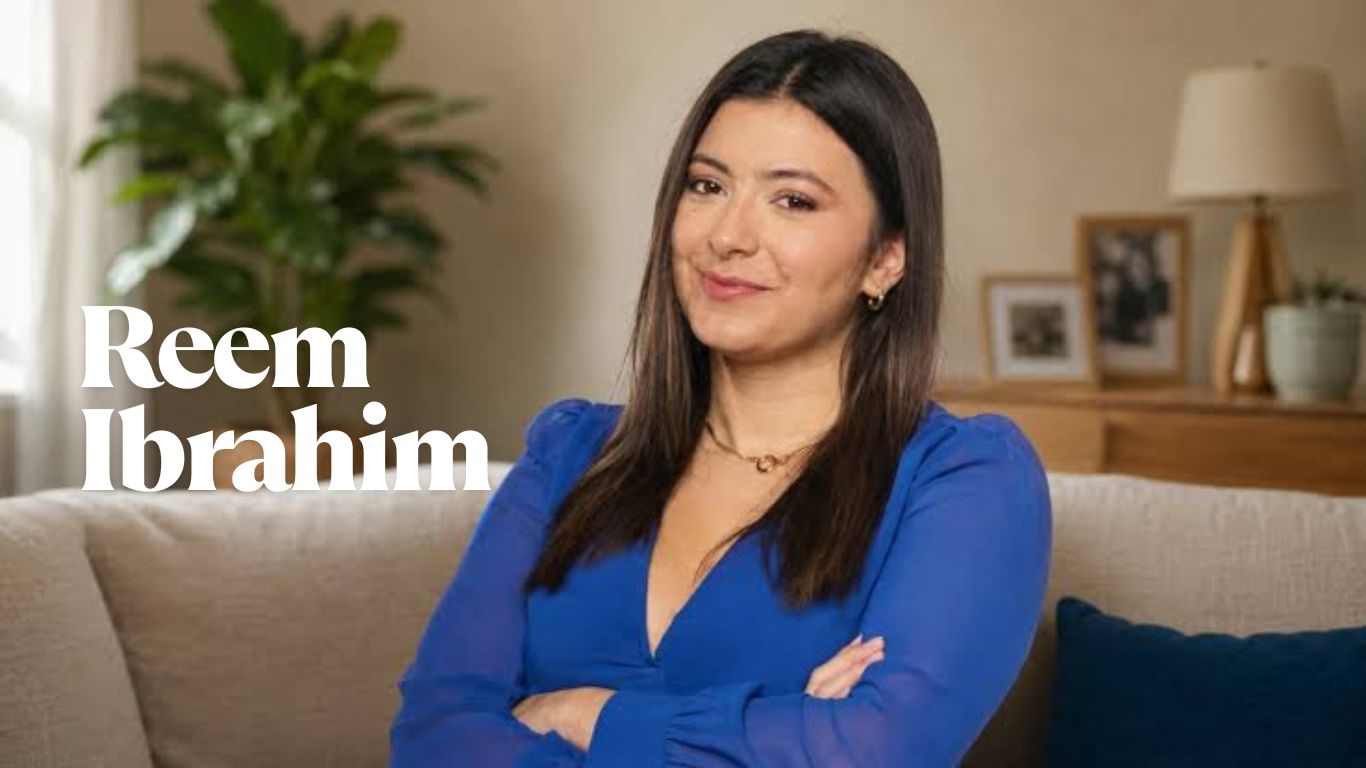
Reem Ibrahim’s age has been one of the most sought-after details about her because of how quickly she rose to stardom. She is often depicted as a youthful British commentator in her early twenties in publicly accessible media, however more recent profiles put her age at 23. What makes that specific information interesting is not the number itself, but rather the fact that she has already built a significant career in radio, public policy, political debate, and free-market advocacy.
Ibrahim is best known as a digital artist, a British broadcaster, and a media figure connected to the Institute of Economic Affairs. She has taken part in national political debates on issues such as liberty, markets, socialism, consumer choice, vaping, smoking control, housing, and generational politics. The first question that many readers have is simple: how old is Reem Ibrahim? A more relevant subject is what she accomplished at such an early age to become a household name in British commentary.
The Age of Reem Ibrahim and Why It’s Interesting
According to recent public profiles and podcast appearances, Reem Ibrahim is 23 years old. She is typically reported as being in her early twenties, while official public records have not been able to confirm her actual birthdate. It’s crucial to rely solely on confirmed information because, like many public individuals, age information is frequently repeated online without trustworthy sourcing.
The disparity between Ibrahim’s stage of life and her involvement in public discourse accounts for a large portion of the interest in her age. Despite being significantly younger than many of the people she discusses, she frequently appears among seasoned journalists, legislators, economists, and policy specialists.
Her perspective on housing, taxes, employment, and economic opportunities is also influenced by her age. She is in the same age group as younger generations, therefore she doesn’t comment on their issues from the outside. Her ideas have a unique voice because of this connection, especially when she questions the notion that younger voters inherently favour more government or left-wing economic policies.
Childhood and Family History
Reem Ibrahim was raised in Hillingdon, West London, after being born in London. Her family has Moroccan and Egyptian ancestry, which has occasionally been noted in her public profiles.
Ibrahim has generally avoided making her private family life a major aspect of her public character, despite the fact that her cultural heritage plays a role in her personal narrative. Instead of disclosing intimate information about family members or relationships, she has maintained the focus on her work and ideas.
She became interested in musical theatre, narrative, and communication before going into politics and policy. These early hobbies contributed to the development of abilities that would later be useful in public speaking and broadcasting, where self-assurance, effective communication, and captivating presentation are crucial.
Political Development and Education
Ibrahim attended the London School of Economics and Political Science (LSE), one of the top universities in the UK for public policy, politics, and economics. Her career in political commentary and think-tank research was made possible by her academic background.
It’s interesting to note how her political opinions have changed over time. She has freely discussed how, as a teenager, she was first drawn to Jeremy Corbyn’s beliefs before progressively adopting libertarian and classical liberal viewpoints. She frequently brings up this change while talking about her own political career, and it has grown to be a significant part of her personal narrative.
Ibrahim studied the writings of prominent liberal philosophers such Ayn Rand, Murray Rothbard, Milton Friedman, Ludwig von Mises, John Stuart Mill, John Locke, and F.A. Hayek while she was a student. Her opinions on free markets, individual liberty, and the role of government have undoubtedly been impacted by these authors, even though they do not define every viewpoint she has.
From Internet Content to National Media
During the COVID-19 pandemic, Reem Ibrahim started providing political commentary on social media and in short films, which marked the beginning of her public career. Before becoming well-known on traditional television, she, like many younger commentators, had a following online.
Her early writings mostly addressed criticism of socialist policies, personal accountability, and free-market economics. She took a strong ideological stance right away rather than portraying herself as politically neutral. She developed a devoted following thanks to her consistency, which also sparked discussion from others who didn’t share her opinions.
Publicly accessible biographies state that Ibrahim debuted on television at the age of 19. She became one of the UK’s up-and-coming political analysts thanks to the chances and greater public attention that came with entering the national media at such a young age.
Employment at the Institute of Economic Affairs
One of the most well-known free-market think tanks in Britain, the Institute of Economic Affairs (IEA), has been an important part of Ibrahim’s career. She is acknowledged as a Linda Whetstone Scholar and has held positions in media and communications.
She was able to interact with a global network of scholars and activists that support minimal government and economic freedom thanks to the scholarship. Additionally, it enhanced her standing as one of the younger voices in UK policy.
Ibrahim has contributed to conversations about taxation, regulation, consumer choice, public spending, and economic reform through her work at the IEA. Her work has gone beyond study; she frequently participates in interviews, media appearances, and public discussions on topics that impact daily life.
Public Profile and Media Career
Ibrahim has become a frequent contributor to British print, radio, and television media as her prominence has increased. She has expressed her opinions on political and economic matters in major publications, the BBC, LBC, Channel 5, GB News, and TalkTV.
Her message has been largely consistent throughout these presentations. She is in favour of more consumer choice, less government involvement, free markets, and laws that promote personal accountability. She also argues for market-based solutions to public policy problems and critiques socialist economic theories in a large portion of her commentary.
The public’s perception of her work is divided, as is the case with many critics who hold distinct political opinions. While detractors contend that her opinions are too little focused on government interference and closely aligned with free-market orthodoxy, supporters appreciate her willingness to defend economic liberalism from the viewpoint of a younger generation.
Opinions on Consumer Choice, Smoking Policy, and Vaping
Regulation of tobacco and vaping is one of the policy topics most directly linked to Reem Ibrahim. She has defended harm reduction tactics that urge adult smokers to transition to substitutes thought to be less dangerous than regular cigarettes and opposed more stringent regulations on disposable vapes.
Her stance is in line with the more general ideas—personal autonomy, consumer freedom, and minimal government intervention—that guide much of her work. She contends that individuals should be able to make educated decisions about their own health and have access to legal products.
These topics are still hotly debated. Concerns regarding marketing strategies, environmental waste, and teenage vaping are frequently mentioned by proponents of stricter regulations. On the other hand, Ibrahim contends that overly stringent regulations would limit adult smokers’ options and possibly deter them from using less dangerous substitutes.
She has also offered commentary on planned smoking bans that would affect shisha cafés, pubs, and hospitality establishments, frequently emphasising the possible effects on both individual liberties and small companies. These discussions show how her work goes beyond political theory into topics that have a real impact on companies, customers, and daily life, regardless of whether readers concur with her views.
Politics, Public Identity, and Ideology
Ibrahim’s viewpoint is often described as classical liberal or libertarian. Her declared emphasis on free markets, individual liberty, limited regulation, and limitations on governmental power is consistent with these titles. They also help to explain why she is often invited to take part in conversations on capitalism, socialism, and the political views of young people.
Her personal transition from young support for Corbyn-era politics to free-market values clearly defines her public persona. She can use books and policy documents, as well as a change in her own opinions, to support her claims. One of the reasons she appeals to audiences interested in political conversion stories is her personal metamorphosis.
However, labels have the ability to diminish the value of a person’s effort. The easiest way to comprehend Ibrahim’s public positions is to look at the subjects she usually addresses: markets, freedom, personal responsibility, economic opportunity, consumer choice, and resistance to what she views as excessive government control. Given her age, their arguments are especially noteworthy since they defy stereotypes about Gen Z politics.
Private Life, Marriage, and Relationships
There isn’t any hard evidence that Reem Ibrahim is married or has children in the public domain. She has not built her public character around a romantic relationship, marriage, or family life. As a result, a respectable biography shouldn’t assert that it is aware of private material that the writer has chosen to withhold.
Personal queries are often prompted by the public’s curiosity in young commentators. When readers search for age, partner, parents, religion, nationality, salary, and net worth, they occasionally expect to find every detail. However, a person’s public employment has no bearing on their right to privacy.
The majority of the material that is now accessible about Ibrahim is professional and biographical. Her education, media profession, political development, Egyptian and Moroccan ancestry, and London upbringing all have an impact on her public life. Unless Ibrahim herself or reliable sources attest to a relationship or private family arrangement, it is better to avoid making such assertions.
Income and Net Worth Sources
The net worth of Reem Ibrahim is unknown. Any exact number found on substandard biographical websites should be considered speculative at worst and an approximation at best. She is a young media and policy expert, not a celebrity with big entertainment contracts or public company filings that would support wealth estimates.
She may make money from her professional work in media, communications, writing, lecturing, and think-tank activities. Although public comments can raise awareness, visibility does not necessarily translate into the large sums that are sometimes promised online. In the lack of verified financial information, it would be misleading to attach a particular net worth to her name.
A more significant financial structure is the career stage. Ibrahim appears to be just beginning his career in public speaking, writing, radio, policy work, and podcasting. Her current prominence is not so much due to her fortune as it is to her power in a particular branch of British politics.
Criticism and Public Perception
The foundation of Reem Ibrahim’s public character is her youth, confidence, and intellectual clarity. She presents herself as someone who is willing to challenge conventional wisdom regarding socialism, regulation, and the role of the state. As a result, she has piqued the interest of audiences looking for a younger proponent of market economics.
As a result, she is currently the target of criticism. The funding, authority, and capacity to shape public policy of free-market think tanks are often questioned. Commentators who endorse market-based ideas may face criticism from those who believe they disregard structural hurdles, public service requirements, or inequality.
Such tension is part of Ibrahim’s public character. Rather than being a general presenter or a neutral lifestyle figure, she works in political discourse. Her reputation will likely continue to be influenced by how she handles opposition, how detailed her policy arguments are, and how she can connect with audiences outside of her current fan base.
The Present Location of Reem Ibrahim
Reem Ibrahim is currently a well-known young British pundit with a clear ideological identity. She continues to participate in public debates over the Institute of Economic Affairs, markets, liberty, consumer choice, and the future of capitalism and conservatism. Her profile is still especially associated with discussions about whether young people are genuinely shifting to the left or whether there is space for a younger free-market ideology.
Even while the audience is still interested in her age, this is not the only way to view her work. The majority are young, and fewer people become regular media voices in national discussions before they are in their mid-twenties. Her biography is therefore more than just an age search.
The next stage of her public existence will depend on her ability to transcend ideological divides. If she delivers more in-depth reporting, policy details, or public trust, her profile might keep growing. If she stays mostly on discussion panels, her influence may stay limited to the media and think tanks.
Typical Questions
How old is Reem Ibrahim?
Reem Ibrahim’s age of 23 has been made public in recent media and profile materials. Since her exact birthdate does not appear to be generally established by reliable public sources, the most cautious response is that she is in her early twenties and has been publicly identified as 23.
This is important as many online biographies repeat age information without citing a particular source. A responsible profile shouldn’t fabricate a birthday or take a dubious claim at its value.
What is Reem Ibrahim’s reputation?
Reem Ibrahim is a well-known digital developer, presenter, and free market advocate from Britain. She has taken part in public debates on socialism, economics, liberty, regulation, and consumer choice. She has a close relationship with the Institute of Economic Affairs.
Her prominence has grown as she is a younger voice in free-market politics. She is often discussed in relation to Gen Z politics since her views challenge the idea that young people are naturally left-wing.
Where is Reem Ibrahim from?
Reem Ibrahim, a native of London, was raised in Hillingdon, West London. Her family is Egyptian and Moroccan, according to published biographical information.
These details are relevant to her biography, but they shouldn’t be used to deduce anything about her private life. Although she has shared some details of her background with the public, she has generally kept her personal and professional lives apart.
Did Reem Ibrahim attend LSE?
Reem Ibrahim did, in fact, attend the London School of Political Science and Economics. Her studies there have contributed to her interest in political economy, liberty, and free-market philosophy.
She became interested in writers and thinkers associated with libertarianism and classical liberalism as her career as a commentator grew. That intellectual route affected her later public discussions in writing, journalism, and think-tank work.
Is Reem Ibrahim married?
The public does not support Reem Ibrahim’s marital status. There is no mention of a spouse, partner, or kids in her public biography.
Since those details are private till confirmed, it is not a good idea to speculate. The best indicators of her public identity are her work, education, political beliefs, and media participation.
What is Reem Ibrahim’s net worth?
The public’s estimation of Reem Ibrahim’s net worth is inaccurate. Exact figures seen on low-quality biographical websites should be viewed with suspicion unless they are supported by trustworthy financial data.
She most likely earns a living from her professional work in communications, media, writing, opinion, and policy-related activities. However, without validated papers, any exact number would be speculative.
Why do people search the internet for Reem Ibrahim’s age?
Many people search up Reem Ibrahim’s age because of her early prominence in the media and political arenas. She takes part in national conversations that are frequently dominated by more senior commentators and policy specialists as a result of her public employment.
Her age also has an impact on the content of her critique. Because she regularly talks about youth, socialism, capitalism, and economic opportunity, readers are captivated by her own generational history.
To sum up
Reem Ibrahim’s age is a useful starting point, but it doesn’t give the whole story. She is officially described as being in her early twenties, even though recent evidence places her age at 23. Her early achievements, however, had more biographical significance. Her career serves as an example of how quickly a youthful political voice may move from internet comments to national conversation.
Her life to date has been shaped by her upbringing in London, her education at LSE, her shift from left-wing teenage politics to free-market ideals, and her growing engagement in media and think tank communications. She is well-known for her opinions on liberty, markets, consumer choice, and resistance to overbearing state control. For those topics, she has drawn both acclaim and criticism.
Ibrahim is entertaining for reasons other than her youth. This is because she is a clear attempt to establish a more young free-market politics at a time when many people think the opposite is true. Her future influence will depend on how well she converts critical discourse into long-lasting public trust.