

























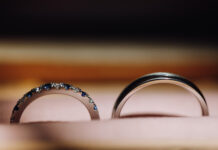






Many individuals choose a wedding ring in the same manner they would choose a phone case: aesthetically, in minimal time, shortly before the actual wedding. Afterward, they have to wear it forever likely paired with a bossy ring that has strong feelings on the malleability and height of other metal. The rings should be viewed not as two separate purchases, but as one device that fits and functions together.
Start with the profile height of your engagement ring
Before you get carried away thinking about your vision of how your wedding band should look and feel, there’s a practical matter to contend with. Check how high your engagement ring’s stone is set above the shank. A solitaire with a lofty prong setting or a halo design leaves a gap underneath the center stone that demands special consideration when shopping for a straight wedding band. If it sits more than a couple of millimeters above your finger, chances are a sliver of light will show between a straight band and the base of your setting, or, worse, the wedding band will rattle against the setting when you move your hand.
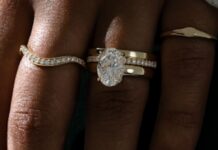
This is a solid geometry problem, and one that requires a curved band, also known as a contour band. These rings feature a sinuous silhouette that wraps gently around the setting, creating a perfect line of continuity between band(s) and ring. A chevron band will also give you a seamless look. This style includes a V-shaped notch that marries neatly against a solitaire, so you can’t see light through the gap. Treating your engagement ring and wedding band as a coordinated pair is exactly why bridal sets exist, and it’s worth browsing a selection of jewellery for your nuptials that’s designed with this pairing problem already solved, rather than piecing it together from two unrelated collections.
Metal choice is a durability decision, not just a color one
Opting to match gold tones is one thing, since it’s often mistakenly viewed as the primary aesthetic concern. The hardness factor is rarely mentioned but just as important. It’s probably the more important factor long-term since it directly impacts how fast your rings look ‘old’.
The hardness of gold is 2.5-3 on the Mohs hardness scale. That means quite a few things. A stack of solid gold rings will wear more quickly where they rub against each other. Gold chains tangle and the surfaces scratch. If your wedding band is set with diamonds and your engagement ring is softer gold, the harder stones in the band will slowly abrade the softer metal every time the two rings touch, which is constantly. That doesn’t mean you need to avoid mixing metals or stone-set bands. It means going in aware. If you love the look of a diamond-set band next to a gold engagement ring, expect some surface wear over the years and plan on periodic polishing. If you’d rather avoid that maintenance entirely, a plain band in the same metal as your engagement ring sidesteps the issue completely.
Remember that 18k gold falls on the top of that range, being purer and softer. 14k gold, with its proportion of stronger metals, is more durable and closer to 2.5. Neither is wrong, but they should match or be chosen deliberately, not by accident.
Stones on the band mean upkeep on the ring
A pavé or channel-set wedding band is stunning. It’s like a river of sparkle flowing around your finger. It also means dozens of tiny diamonds sitting directly against your engagement ring’s prongs, day after day, for years. That repeated contact can gradually loosen prongs on the engagement ring, which is the kind of thing you don’t notice until a stone shifts or falls out.
That’s not a reason to avoid pavé bands. It’s a reason to get your prongs checked more often if you choose one, and to consider a half-eternity band instead of a full eternity band if resizing flexibility matters to you. To resize a full eternity ring, a jeweler has to deconstruct the whole thing and rebuild it from scratch. It’s a small issue if you’re confident you’ll wear the same size forever. It’s a bigger problem if you’re not, given the possible multiple-thousand-dollar price tag and a few weeks of separation every time you go up or down a half-size or so. Half-eternity styles leave the underside plain, so a jeweler can still adjust the size down the road.
Get the proportions right, then wear both rings together before deciding
The width of your wedding ring should be proportional to the visual weight of your engagement ring, not to current fashion trends. A 2mm band is perfect for a very small stone, but can be overpowered by anything above half a carat. A 4mm band will look lovely with a hefty three-stone or cluster, but might vibe a bit “dad’s college ring” at a size that small. Plus, whatever your actual ring size, the chunkier the band, the larger it’ll appear across your finger, and vice versa. Middle-of-the-road widths like 2.5mm for particularly small stones or under 2-carat “average” stones are hard to visually assess this way, but once you’ve got a feel for what you’re looking at you can squint through the glass and get a rough idea.
Width is ultimately a matter of trial and error, because the way that a certain ring looks can’t be predicted by the ring’s measurement alone. A 4mm band might be as wide as you think you’d ever want to go until you try on a 5mm band and see how much you love it. Or it might be a stick-to-your-guns deal where you will never bow to the 5/6/8mm trend because the proportions-offend-your-aesthetic-sensibility thing is real. But not until the experiment’s been run.
Comfort-fit interiors – the rounded inner edge that reduces pinch points – matter more for daily wear than any amount of milgrain detailing or texture. You’ll feel the interior shape every day. You’ll notice the milgrain maybe once a month. The real test, though, is trying both rings on together and looking down at your hand the way everyone else will. Not the profile view, not the macro photo. The bird’s-eye view. That’s the angle that needs to read as one cohesive piece of jewelry rather than two rings that happen to share a finger.
Wedding bands don’t get upgraded every few years the way other jewelry might. Whatever you pick has to survive dishes, gym sessions, cold weather, and decades of sitting flush against another ring that isn’t going anywhere. Get the geometry and the metallurgy right first, and the style part takes care of itself.