




























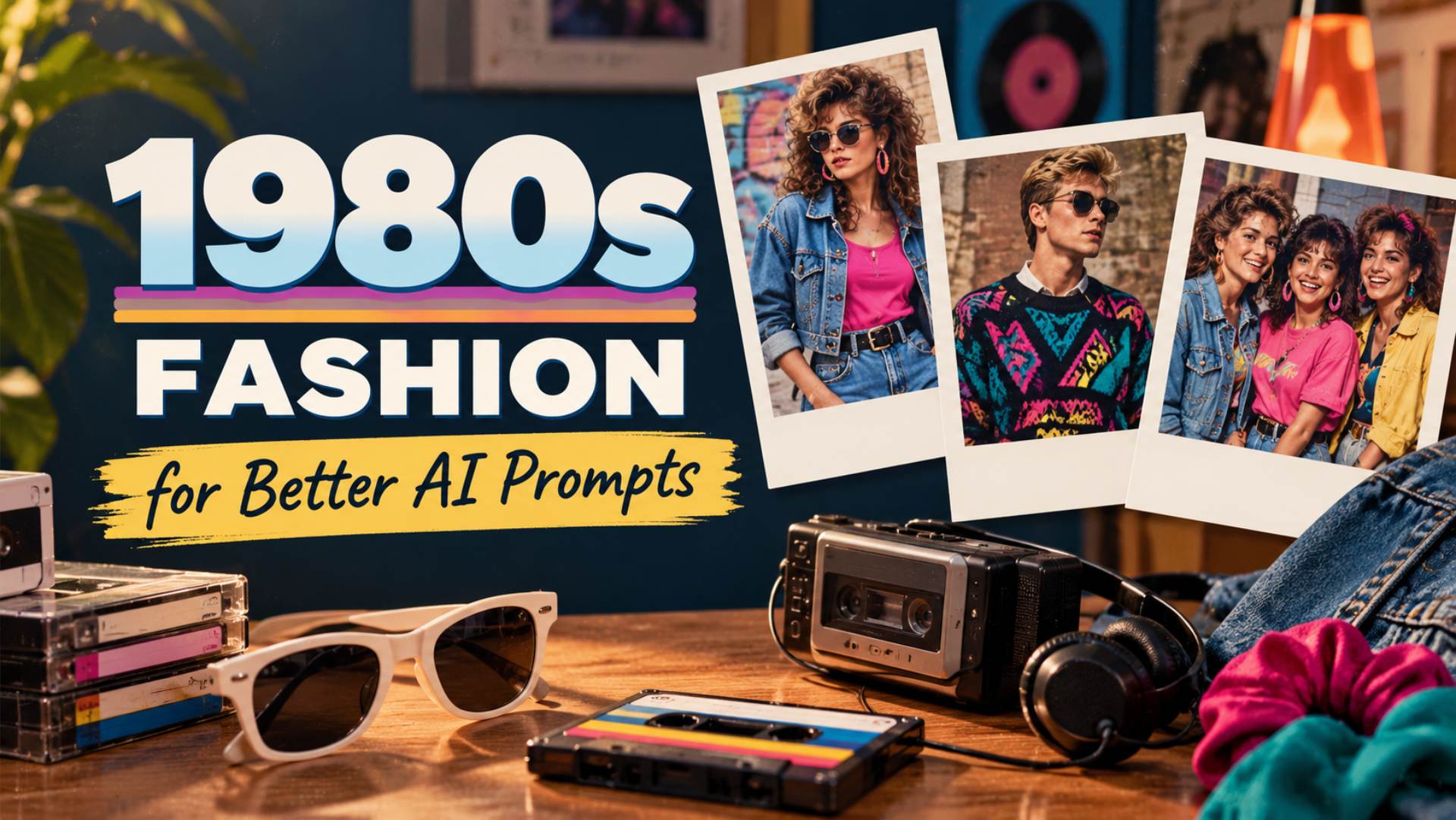
“Make my outfit look 80s” is one of the least useful instructions you can give an AI image tool, because it leaves the model to guess which 1980s you mean — and it usually guesses something garish and generic. The fix is vocabulary. The more precisely you can name what you actually want, the less room there is for the AI to default to a costume-shop cliché.
This A-Z of 1980s Fashion is a reference, not a prompt list — a glossary of the actual terms worth knowing, from the clothing itself through to the hair and make-up that finished the look. Drop any of these into the prompts elsewhere in this series, or into one you’re writing from scratch, and you’ll get a noticeably more specific, more convincing result than “80s style” ever will.
Key Takeaways
- Specific fashion terminology helps AI create more convincing 1980s outfits than vague instructions such as “make it look 80s.”
- Use only two or three compatible fashion details in one prompt to avoid creating an exaggerated fancy-dress look.
- Details such as shoulder pads, acid-wash denim, shell suits, geometric prints and period hairstyles can make an image feel more authentic.
- Match clothing, accessories, hair and make-up to the same occasion or subculture for a more consistent 1980s Fashion Aesthetic.
- The best AI Prompts for 80s Fashion combine precise clothing terms with suitable lighting, setting and photographic style.
How to Use This
Pick one or two terms per outfit rather than working through the alphabet in a single prompt — a shell suit and a sequinned evening dress in the same outfit reads as a jumble sale, not a photograph. The most convincing 1980s images tend to come from a single, coherent idea (one silhouette, one colour story, one occasion) described precisely, not a greatest-hits list of everything the decade produced. The best 80s Fashion Trends to recreate are usually the ones tied to a clear occasion, silhouette and styling direction rather than several unrelated references at once.
The Glossary
Acid-Wash Denim — Denim treated to give it a mottled, bleached, marbled appearance, popular for jackets and jeans alike. Far more distinctive in a prompt than plain “denim.”
Batwing Sleeve — A sleeve cut wide and deep at the armhole, narrowing to a fitted wrist, giving a draped, winged silhouette when the arm is lowered. Common on jumpers and eveningwear.
Bomber Jacket — A short, waist-length jacket with a ribbed collar, cuffs and hem, often in leather or nylon. Works well for street-style and nightlife prompts alike. Pieces like this are useful sources of 1980s Style Inspiration because they immediately suggest a setting, mood and type of outfit.
Bum Bag — A small pouch worn on a belt around the waist, usually at the front or hip. A tiny detail that adds a surprising amount of period accuracy to a casual outfit.
Colour-Block — Garments built from large, flat blocks of contrasting solid colour rather than a print — think a jacket in navy, red and white panels rather than a patterned fabric.
Crimped Hair — Hair styled with a crimping iron to produce tight, zigzag waves throughout its length, distinct from a looser curl or wave.
Deely Boppers — A novelty headband with two springs, each topped with a small ball or shape, that bounce as the wearer moves. A playful, unmistakably period detail for a party or disco scene.
Epaulette Jacket — A zip-front jacket with a stand collar and decorative shoulder tabs (epaulettes), extremely popular for both men and women through the early-to-mid 80s. Specify this rather than just “jacket” for an instantly recognisable silhouette.
Feathered Hair — Hair cut and styled in soft, layered wings that sweep back and slightly upward from the face, often associated with the earlier part of the decade.
Geometric Print — Fabric patterned with bold, angular shapes — triangles, zigzags, abstract blocks — rather than florals or stripes. A strong choice for New Wave and synth-pop styling. Details such as geometric prints are particularly useful when building Retro Fashion for AI Prompts, because they give the model a clear visual direction instead of a vague decade reference.
Houndstooth — A two-tone pattern of broken, jagged checks, commonly used on blazers and coats for a smarter, more tailored 80s look.
Iridescent Eyeshadow — Eye make-up with a shimmering, colour-shifting finish, often in blue, violet or teal — a strong, specific alternative to just saying “colourful make-up.”
Jelly Shoes — Sandals or flats moulded from brightly coloured, translucent PVC. A small footwear detail that reads as unmistakably period, especially for a beach or summer scene.
Knee-High Boots — Boots reaching to or just below the knee, often worn over leggings or with a mini skirt — a staple of both smart and going-out 80s outfits. This makes knee-high boots one of the easiest starting points for practical 80s Outfit Ideas, especially when paired with a simple skirt, leggings or oversized knit.
Leg Warmers — Knitted tube-shaped sleeves worn over the lower leg, originally a dancewear item that became mainstream streetwear. Essential for any aerobics or dance-themed prompt.
Mullet — A haircut kept short at the front, top and sides but left long at the back. One of the single most recognisable period signals available, but best paired with an otherwise restrained outfit rather than piled on top of other loud choices.
Neon — Extremely bright, almost fluorescent colour, most authentic when used for accents (a single item or accessory) rather than an entire outfit.
Off-the-Shoulder Top — A top or jumper worn pulled down to expose one or both shoulders, closely associated with dance and fitness culture as well as evening looks.
Parachute Trousers — Trousers cut from lightweight, often slightly shiny fabric, typically tapered at the ankle with a looser fit through the leg, associated with breakdancing and street style.
Perm — Chemically set curls, ranging from tight and voluminous to loose and wavy, worn by all genders through the decade. Specify tight, loose or spiral for a more precise result.
Puffball Skirt — A short skirt gathered at the hem so it balloons outward, often in taffeta or satin for eveningwear.
Quiff — Hair swept upward and back from the forehead into a raised front section, often associated with a sharper, more stylised look.
Ra-Ra Skirt — A short, tiered skirt with layered, frilled edges, similar in spirit to a cheerleading skirt, popular across both casual and going-out styling.
Shell Suit — A tracksuit made from a shiny, rustling synthetic fabric, usually in bold colour-blocked panels. A strong, very specific late-80s reference. The shell suit remains one of the most instantly recognisable examples of Iconic 1980s Clothing, particularly for casual and sportswear-inspired scenes.
Shoulder Pads — Padded inserts worn inside a jacket or top to broaden and square the shoulder line. Specify the degree — subtle or pronounced — since this varied hugely across the decade and by garment type.
Stonewash Denim — Denim washed with pumice stones to create a faded, mottled texture, softer and less contrasted than acid-wash.
Tracksuit — A matching top and trousers set, most period-accurate in bold colour-blocking or a single bright colour, worn as much as streetwear as for actual sport.
Upturned Collar — A shirt, polo or jacket collar deliberately worn flipped up rather than lying flat — a small styling choice that adds a lot of period attitude to an otherwise simple outfit.
Varsity Jacket — A jacket with knitted ribbed collar, cuffs and hem, wool body and leather sleeves, associated with American collegiate style but widely worn well beyond that context.
Wayfarer-Style Sunglasses — Angular, thick-framed plastic sunglasses with a distinctive trapezoid lens shape — describe the shape rather than a brand name for a reliably period-accurate result.
Windbreaker — A lightweight, often brightly coloured or colour-blocked zip-up jacket, worn for both sport and casual streetwear.
Wristbands — Thick, towelling sweatbands worn around the wrist, either purely for the athletic look or as a general fashion accessory.
Yuppie Power Suit — A sharply tailored, broad-shouldered suit associated with ambitious young professionals — pair with a briefcase or an early mobile phone prop for a complete “corporate 80s” scene.
Zigzag Print — A bold, angular repeating pattern, often in high-contrast colour combinations, associated with both sportswear and New Wave styling.
(There’s no strong, period-specific term for X — glossaries like this one tend to have a gap there, and it’s not worth forcing one.)
Combining Terms Without Overdoing It
The point of having this vocabulary is precision, not a shopping list. A prompt that says “shoulder pads, a shell suit, leg warmers, deely boppers and a mullet” all at once will read as a fancy-dress costume rather than a photograph, because no single real outfit from the era combined all of these at once. When working with Vintage 80s Fashion, pick the one or two terms that define the specific look you’re going for — a yuppie power suit for a corporate portrait, a shell suit and leg warmers for an aerobics scene, a bomber jacket and stonewash denim for a casual street shot — and let the rest of the prompt do the remaining work. (the setting, the lighting, the film character) do the remaining work.
FAQs
Do I need to use exact terminology, or will the AI understand a rough description?
Most tools will understand a rough description, but a precise term consistently produces a more accurate, less generic result — the same reason a stylist’s brief works better than “make it look nice.”
Which single term makes the biggest difference to a prompt?
Shoulder pads, specified with a degree (“subtle” or “pronounced”), tends to have an outsized effect on how period-accurate an outfit reads, more so than almost any other single detail.
Are these terms specific to Britain, or do they work for other countries’ 80s looks too?
Most of these were genuinely international — shoulder pads, perms and acid-wash denim showed up across the US, UK, Europe and beyond. A few, like the bum bag (called a “fanny pack” in the US) or specific slang, vary by region, so it’s worth adjusting terminology slightly for a specific country’s prompt.
Can I use more than one term from this list in a single prompt?
Yes. When writing AI Prompts for 80s Fashion, keep it to two or three terms that plausibly belong to the same outfit and occasion rather than combining details from different subcultures or dress codes.
What if the AI still gets the garment wrong even with the specific term?
Add a one-line description alongside the term the first time — “a bomber jacket, a short waist-length jacket with a ribbed collar and cuffs” — which tends to anchor the result more reliably than the term alone.
Final Thought
Vocabulary is doing more work in these prompts than most people expect. That level of precision is what makes a convincing 1980s Fashion Aesthetic feel like a real period photograph rather than a generic retro costume. Keep this list open next to whichever prompt you’re writing, and reach for the precise term rather than the vague one.