

































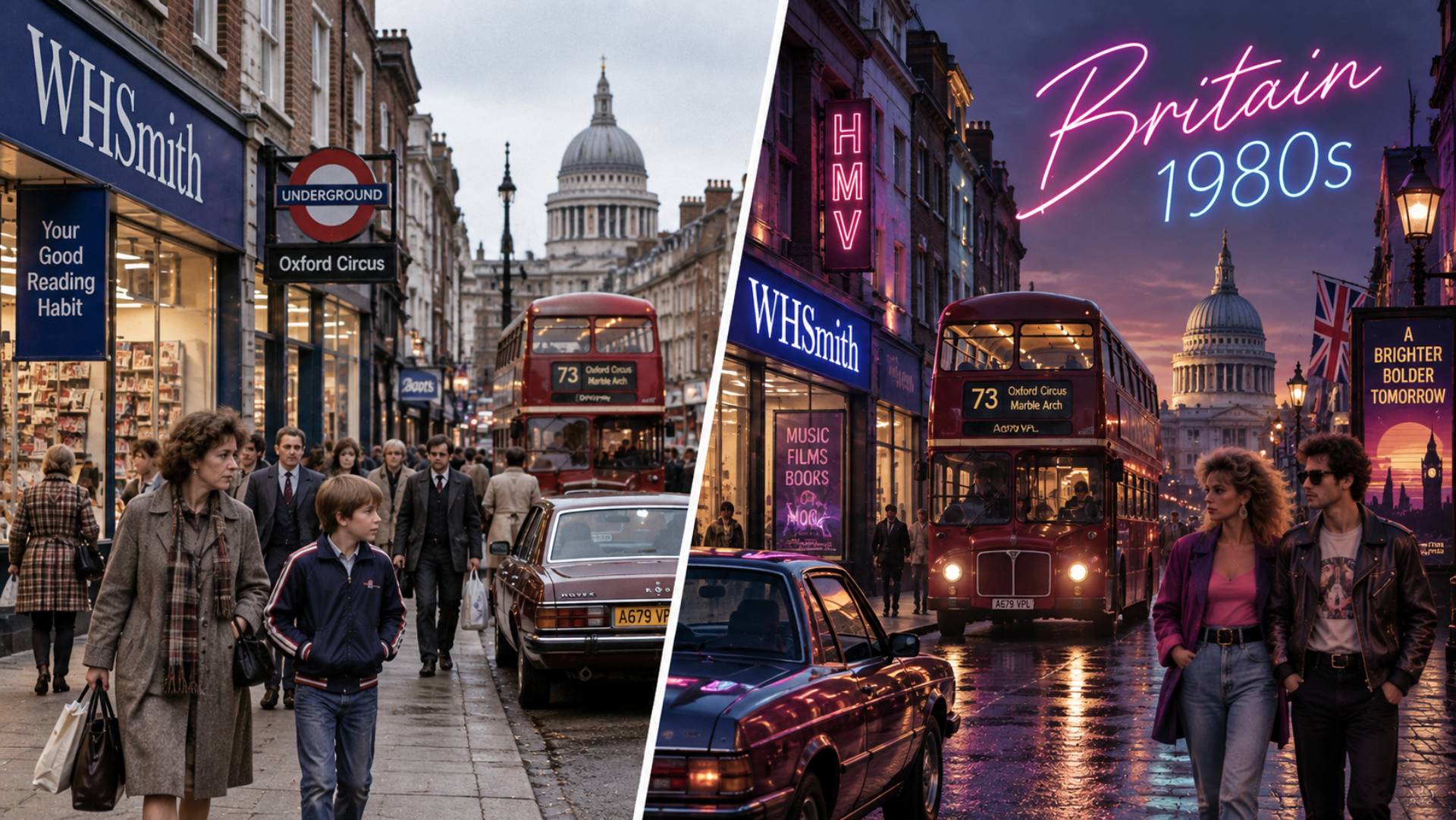
The Real British 1980s Versus the AI Version
Ask an AI image generator to recreate Britain in the 1980s, and it will probably reach for neon lights, enormous hair, leather jackets, cassette players and a red London bus glowing in the rain. The result may be attractive, but does it resemble the decade most British people actually experienced?
Only partly.
The 1980s certainly produced bold fashion, influential music, striking advertising and some wonderfully theatrical photography. Yet everyday Britain was usually less polished than its AI reconstruction. Family sitting rooms were more likely to be brown or beige than neon pink. High streets were busy but not permanently cinematic. Holiday photographs were often crooked, overexposed or interrupted by a stranger walking through the frame.
Artificial intelligence tends to recreate the decade through its most recognisable symbols. Real life was more varied, regional and ordinary. That gap between memory and machine-made nostalgia is what makes the current 1980s AI photo craze so interesting.
Why AI Has Its Own Version of the 1980s
AI image tools don’t remember Britain the way a person does. They identify visual patterns from the images and descriptions used during their development. When asked for “1980s Britain”, they assemble details strongly associated with the period.
That creates a compressed version of the decade. The model may combine a New Romantic hairstyle, punk clothing, neon nightclub lighting, a cassette Walkman, a red telephone box and a sports car in one scene. Each element connects to the era, but the combination may not represent a moment that would commonly have existed.
This happens because unusual images are easier to recognise than ordinary ones. A flamboyant pop star, dramatic music-video set or colourful fashion editorial communicates “1980s” immediately. A family sitting around a gas fire watching television may be more authentic, but its decade is harder to identify at a glance.
AI therefore gives us a heightened memory: not necessarily false, but selective.
AI Britain and Real Britain at a Glance
| Part of life | The AI version | The more common reality |
|---|---|---|
| Fashion | Shoulder pads, leather and neon everywhere | A mixture of ordinary knitwear, denim, work clothes, school uniforms and occasional statement fashion |
| Homes | Colourful retro interiors filled with period objects | Brown, cream and floral rooms gradually updated over many years |
| Streets | Wet London roads, red buses and glowing signs | Suburban parades, market towns, estates, industrial streets and regional city centres |
| Photography | Carefully composed cinematic portraits | Direct flash, soft focus, awkward poses and imperfect consumer film |
| Music culture | Synth-pop and New Romantic glamour | Pop, rock, ska, punk, metal, soul, reggae, indie and emerging dance scenes |
| Technology | Every famous gadget placed in one room | A few expensive devices shared by the household |
| Holidays | Perfect seaside nostalgia | Windbreaks, changing weather, packed lunches, arcades and unpredictable snapshots |
| Colour | Saturated neon pink, purple and blue | Muted prints, warm colour casts, brown furnishings and fading album photographs |
The right-hand column is not the only truth either. Britain contained many different lives. A fashionable London club, a Welsh mining community, a Glasgow tenement, a Midlands suburb and a Cornish holiday park could all belong to the same year without looking remotely alike.
British Fashion Was Bolder, but Not Everyone Dressed Like a Pop Star
Fashion is where AI exaggeration shows up most clearly. Generated pictures often put everyone in oversized shoulder pads, mirrored sunglasses, leather trousers, or fluorescent sportswear.
Those styles have genuine roots in the decade. Power dressing became associated with ambition and professional confidence. New Romantic fashion celebrated make-up, dramatic hair and historical influences. Punk continued to shape street style, while sportswear, denim, shell suits and casual football fashion became increasingly visible.
But most people did not dress for a music video every morning.
Ordinary wardrobes included cardigans, sensible coats, knitted jumpers, blouses, polo shirts, jeans and clothes carried over from the previous decade. What someone wore depended on age, income, occupation, location and whether they were going to work, school, a wedding or a nightclub.
Clothing also changed across the ten years. An outfit from 1981 could look noticeably different from one worn in 1989. A convincing AI 1980s prompt should therefore specify a year and occasion instead of requesting a general “1980s outfit”.
What AI often gets wrong about the clothes
- It uses fluorescent colours for every garment.
- It mixes punk, New Romantic, power-dressing and rave influences in one outfit.
- It dresses ordinary families as celebrities or fashion models.
- It makes clothes appear newly manufactured rather than worn and lived in.
- It ignores regional, occupational and class differences.
A realistic picture might be less spectacular, but a modest raincoat, patterned jumper and comfortable shoes may say more about daily British life than another neon leather jacket.
The Real British Home Was Often Brown, Floral and Gradually Modernised
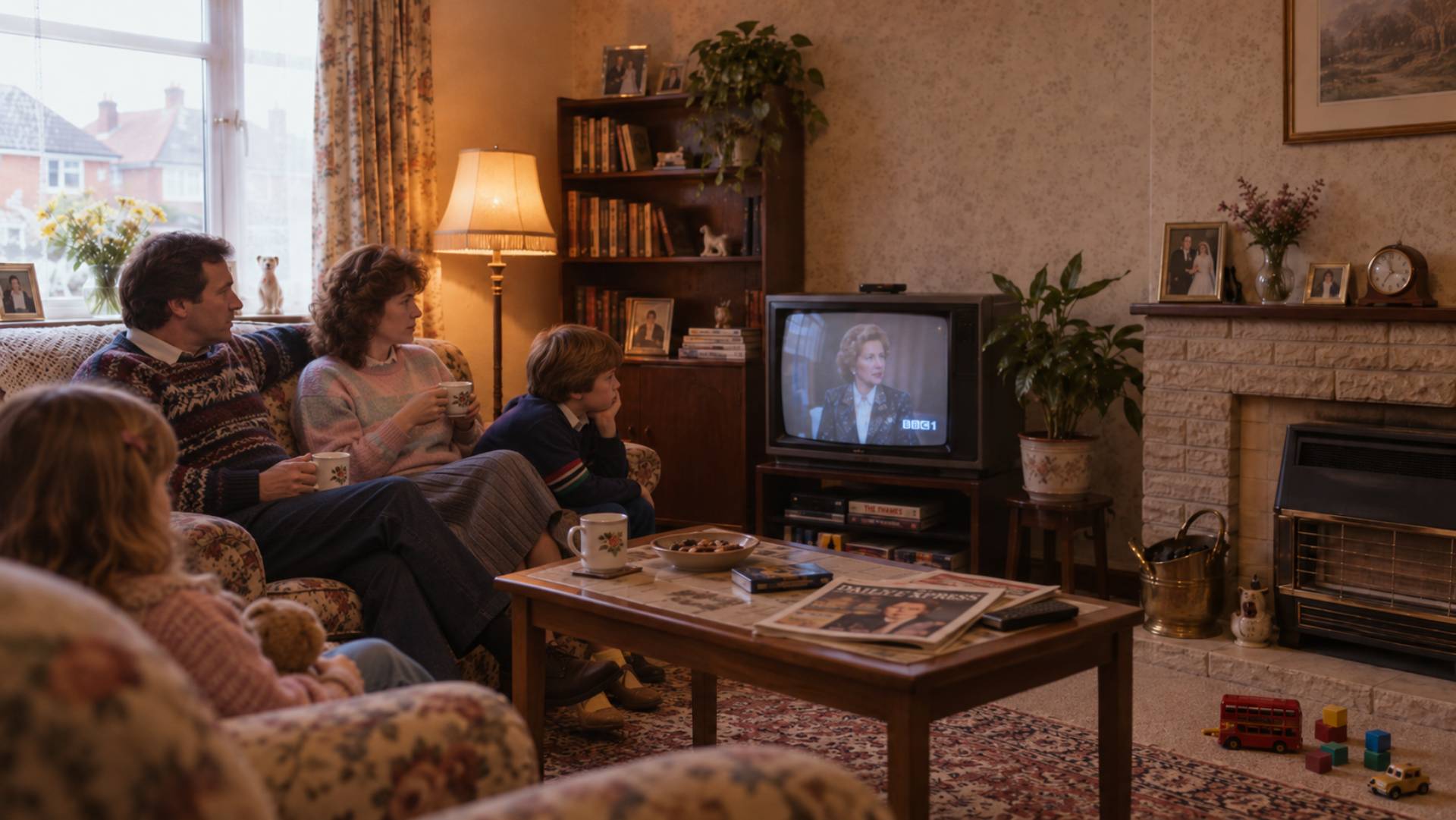
AI-generated 1980s interiors tend to resemble carefully designed retro sets. They contain a box television, rotary telephone, cassette deck, patterned carpet, record player, VHS recorder and several brightly coloured ornaments, all perfectly arranged.
Some homes did contain many of these things, but domestic change did not happen all at once. Families replaced furniture and appliances when they could afford to, which meant that objects from the 1960s and 1970s remained in use throughout the 1980s.
A typical room might include a floral three-piece suite, heavy curtains, a gas or electric fire, family photographs, a wooden television cabinet, lace covers, patterned wallpaper and a carpet chosen years earlier. In another household, the interior might be more modern, minimal or influenced by contemporary design.
The television was an important focal point, but not every room was crowded with technology. A video recorder could be a prized and expensive household item. A home computer might belong to one child or be shared by the entire family. Telephones were fixed in place, and conversations were rarely private if the handset was in the hall or sitting room.
The most believable AI interiors include a few carefully chosen objects. When every famous 1980s gadget appears together, the room starts to look like a museum display.
Family Photography Was Imperfect, and That Was Part of Its Character
Modern AI portraits are often too accomplished. Faces are evenly lit, clothes fall perfectly and backgrounds carry a fashionable cinematic blur. Real family photographs were rarely so controlled.
Many pictures were taken on compact film cameras by relatives rather than professional photographers. People waited for the film to be developed before discovering whether someone had blinked, the flash had failed or a finger had partly covered the lens.
Common features included:
- Direct on-camera flash and hard shadows
- Slightly missed focus
- Red-eye
- Crooked framing
- Muted or shifting colours
- Date stamps on later consumer photographs
- Limited numbers of exposures
- Prints that faded, scratched or changed colour over time
Because film cost money to buy and process, people did not take dozens of versions of the same moment. The imperfect photograph was often the photograph that went into the album.
AI usually treats ageing effects as decoration. It may add heavy grain, dust and orange colour to every image. Real film varied by camera, lighting, film stock, processing, and storage. A photograph printed in 1987 would not necessarily have looked faded at the time; that appearance may have developed over the following decades.
For a convincing reconstruction, it helps to decide whether the image should resemble a newly developed 1980s print or an old photograph being viewed today.
Britain Was Much Bigger Than AI’s Version of London
When asked for a British setting, AI often defaults to London. Red buses, black cabs, telephone boxes, Big Ben and wet pavements become visual shorthand for the entire country.
London is an important part of the story, but 1980s Britain also meant terraced streets in Northern England, industrial towns in the Midlands, Scottish cities, Welsh valleys, coastal communities, rural villages, suburban estates and new shopping centres.
Even within London, life extended far beyond the landmarks. Most residents experienced local high streets, council estates, parks, railway stations, corner shops and ordinary journeys to work.
Regional specificity makes an AI image more believable. A prompt set in Manchester, Belfast, Cardiff, Glasgow, Birmingham, Newcastle or Brighton should not simply reuse the same London scene with a different place name.
Architecture, weather, topography, signs, public transport and local industries all shape a place. So do small details: the kind of stone or brick used in buildings, the design of a bus stop, the width of a street and the clothing chosen for the climate.
The British High Street Was Busy, Useful and Far Less Polished
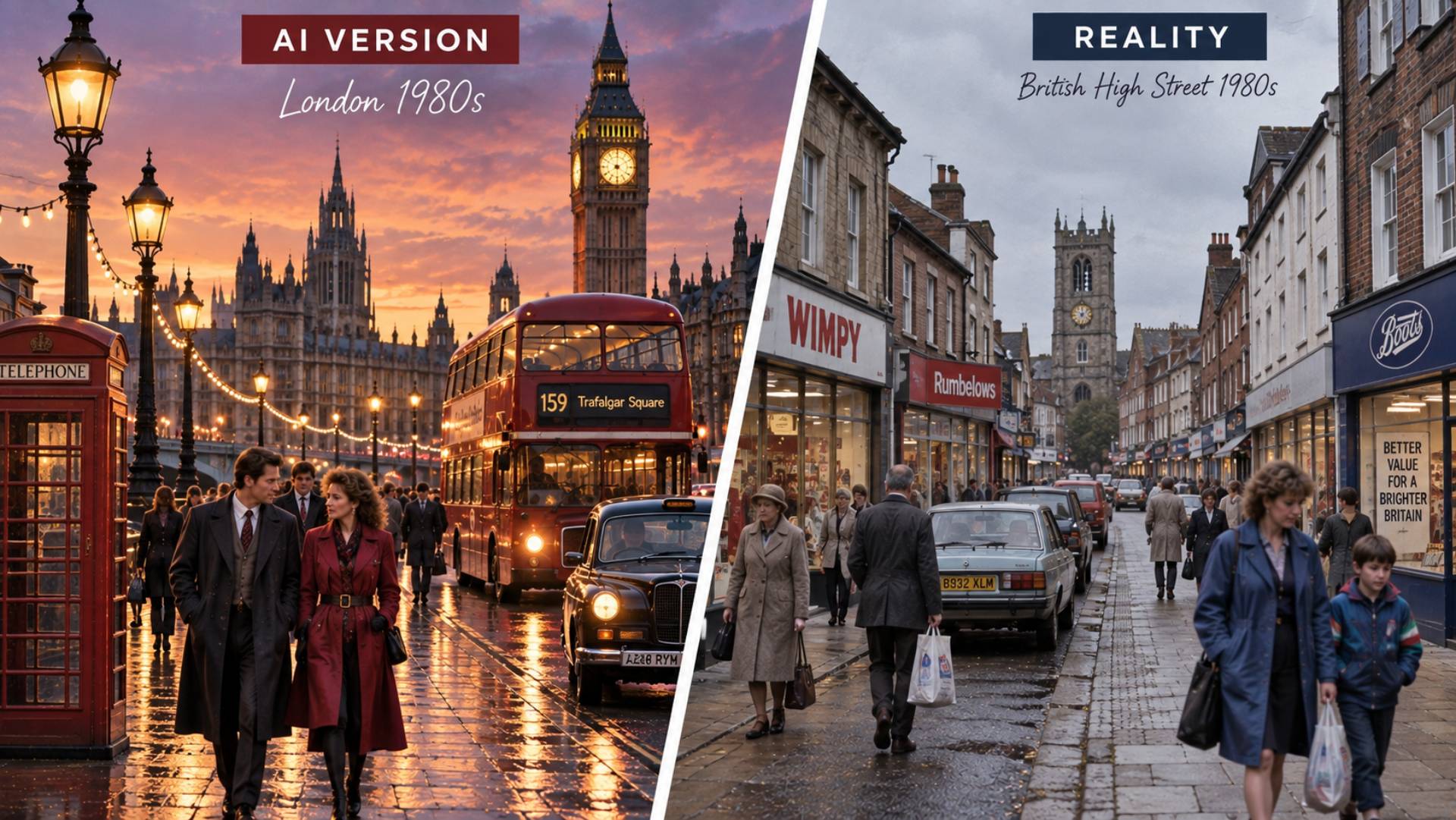
The 1980s high street was a place for shopping, banking, meeting people and browsing. Department stores, record shops, newsagents, electrical retailers, photo-processing counters, cafés, building societies and video rental shops all played a part.
AI tends to make these streets either attractively nostalgic or theatrically run-down. The everyday reality sat between those extremes. Shopfronts were not coordinated for visual effect. Delivery vans, handwritten notices, litter bins, roadworks and mismatched signs interrupted the scene.
Shopping habits also changed during the decade as larger stores, retail parks and shopping centres grew in importance. Yet local high streets remained essential to many communities.
An accurate AI scene should resist filling every shop with a famous surviving brand. Independent businesses, local names and generic shopfronts would often be more plausible. Any readable text also needs careful checking, because generated signs can easily become nonsense.
British Music Was More Than Synth-Pop
Synth-pop gives AI a convenient set of visual signals: glowing keyboards, geometric graphics, metallic clothing and blue or magenta light. New Romantic imagery is equally recognisable.
Both belong in the decade, but British music culture was far broader. Pop, post-punk, ska, reggae, heavy metal, soul, indie and electronic dance music attracted different audiences. Live venues, youth clubs, pubs, bedrooms and record shops mattered alongside glamorous television performances.
The setting should match the music. A small local gig would not look like a high-budget video. A teenager listening to records at home would not need theatrical nightclub lighting. A late-decade dance scene should not be placed in 1981.
AI becomes more accurate when a prompt identifies the specific musical culture, year and type of venue rather than merely asking for a “British 1980s music scene”.
The Great British Seaside Holiday Was Not Always Sunny
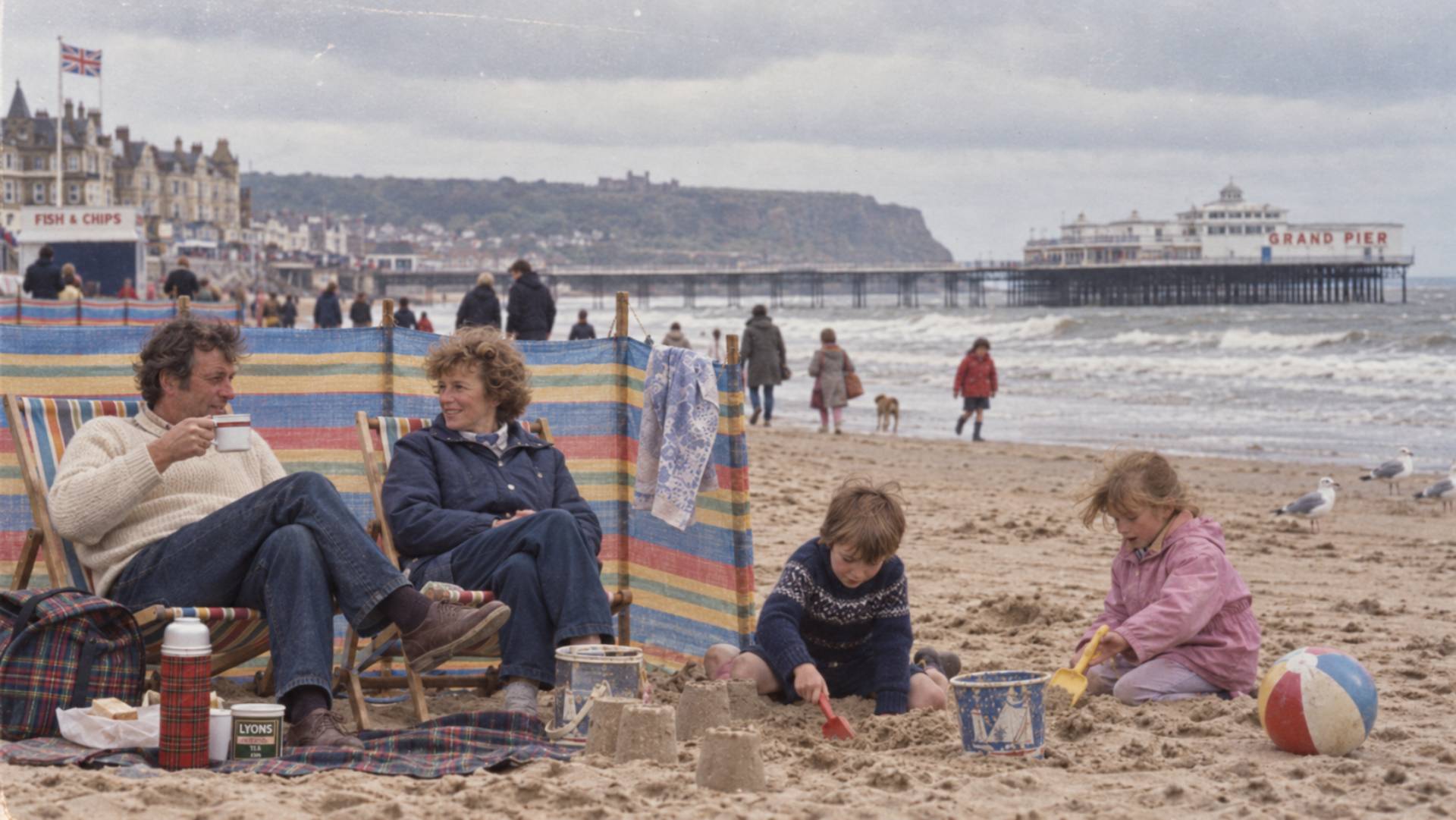
The seaside is perfect territory for nostalgic AI imagery. It offers amusement arcades, deckchairs, striped windbreaks, piers, fish and chips and brightly painted signs.
The machine-made version often arrives under a flawless blue sky. Real British holidays were more dependent on changeable weather. Families wore jumpers on the beach, sheltered from the wind and continued with their plans when clouds appeared.
Photographs captured children carrying buckets and spades, adults sitting behind windbreaks, crowded promenades, guest houses, holiday camps and amusement arcades. The scenes could be cheerful without being polished.
Places such as Blackpool, Brighton, Bournemouth, Scarborough and many smaller resorts each had their own appearance. A useful prompt should name a location and avoid combining every seaside symbol in the same frame.
School Life Was More Ordinary Than the AI Reconstruction
AI often represents a British 1980s school through chalkboards, stern teachers, perfect rows of wooden desks and children in unusually old-fashioned uniforms. The result can drift towards the 1950s or an imaginary boarding school.
Real classrooms varied, but they might contain exercise books, overhead projectors, wall charts, metal-framed chairs, cassette recorders and early computers. School buildings ranged from Victorian structures to post-war blocks and newer comprehensives.
Uniforms were not identical across the country, and many pupils did not attend elite-looking schools. Hairstyles, bags, trainers, coats and playground culture often communicated the period more accurately than exaggerated classroom props.
A believable school scene should specify the kind of school, region, age group and exact year.
AI Makes the Decade Cleaner and More Cinematic
The strongest difference is not any single object. It is atmosphere.
AI turns everyday history into a production. Streets are lit like film sets. Rooms are perfectly colour-coordinated. People pose with contemporary confidence. Every object announces its decade.
Real life contained visual clutter, awkwardness and contradiction. An old armchair could sit beside a new video recorder. A fashionable teenager might stand in front of outdated wallpaper. A modern office building could contain desks and filing systems that had barely changed for years.
These contradictions make an image convincing. History does not replace itself on 1 January at the beginning of a new decade. It accumulates.
What AI Gets Right About the British 1980s
AI is not simply wrong. It can capture several genuine qualities of the period particularly well.
It understands that fashion became a stronger form of identity. It can evoke the importance of music, youth subcultures and magazines. It recognises the visual impact of analogue technology, printed photographs and bold graphic design. It can also recreate the excitement people felt around home computing, video, electronic music and changing urban culture.
Most importantly, AI encourages people to look more closely at the past. A generated portrait may prompt someone to open an old album, ask relatives about their clothes or identify the camera used for a family photograph.
Used thoughtfully, the technology can begin a conversation with history rather than replace it.
How to Create a More Authentic British 1980s AI Image
Choose an exact year
The early and late 1980s were not visually identical. Selecting a year prevents the model from combining an entire decade.
Name a specific British location
Choose a city, town, suburb, seaside resort or rural setting. Describe the kind of street or building instead of relying on landmarks.
Decide whose life is being shown
Age, occupation, income, interests and occasion affect clothing and surroundings. An office worker, school pupil, musician and family on holiday should not look interchangeable.
Keep some older objects
A room in 1986 could still contain furniture bought in 1974. A small amount of visual carry-over makes the scene more natural.
Reduce the famous symbols
One cassette player may be useful. A cassette player, Rubik’s Cube, home computer, video recorder, arcade machine, boombox and neon sign in the same sitting room are too much.
Ask for consumer photography
If you want a family-album look, specify direct flash, ordinary composition, modest sharpness and period consumer film. Do not request cinematic lighting.
Include imperfections carefully
Slightly awkward posture, gentle colour fading or imperfect framing can help. Heavy scratches and extreme grain usually look artificial.
Remove modern intrusions
Ask the tool to exclude smartphones, LED screens, contemporary vehicles, modern shop branding, wireless devices and recent street furniture.
Three Prompts: From AI Cliché to British Reality
1. British family sitting room
Weak prompt:
Create a British family in an amazing neon 1980s living room with every retro gadget.
Improved prompt:
Create a natural family snapshot taken in a modest Birmingham sitting room in 1986. Show two parents and two children in ordinary weekend clothing, preserving their recognisable faces and natural skin tones. Include a floral three-piece suite, patterned carpet, gas fire, wooden television cabinet and one VHS recorder. Allow some furniture to look older than the decade. Use direct compact-camera flash, slightly awkward framing and realistic consumer colour film. Exclude neon lighting, cinematic posing and modern devices.
2. British high street
Weak prompt:
Show a cool 1980s British street with red buses, punks and neon shops.
Improved prompt:
Recreate an ordinary Manchester high street on an overcast Saturday in 1984. Include a mixture of independent shops, a newsagent, building society, bus stop, parked period cars and shoppers wearing practical coats and everyday clothes. Use documentary street photography, natural grey daylight, mild film grain and slightly muted colour. Avoid London landmarks, neon signs, fashion-model poses and readable invented brand names.
3. British seaside holiday
Weak prompt:
Make a perfect sunny 1980s British seaside holiday.
Improved prompt:
Turn the uploaded family photograph into a candid seaside snapshot taken in Scarborough in 1988. Preserve each person’s identity, age and skin tone. Dress them in ordinary holiday clothes with light jumpers because the weather is cool. Add a striped windbreak, buckets and spades, a busy beach and a cloudy sky with occasional sunlight. Use casual consumer-camera composition, direct flash where appropriate and the look of a newly developed late-1980s colour print. Remove modern buildings, clothing and devices.
How to Compare a Real Photograph With an AI Recreation
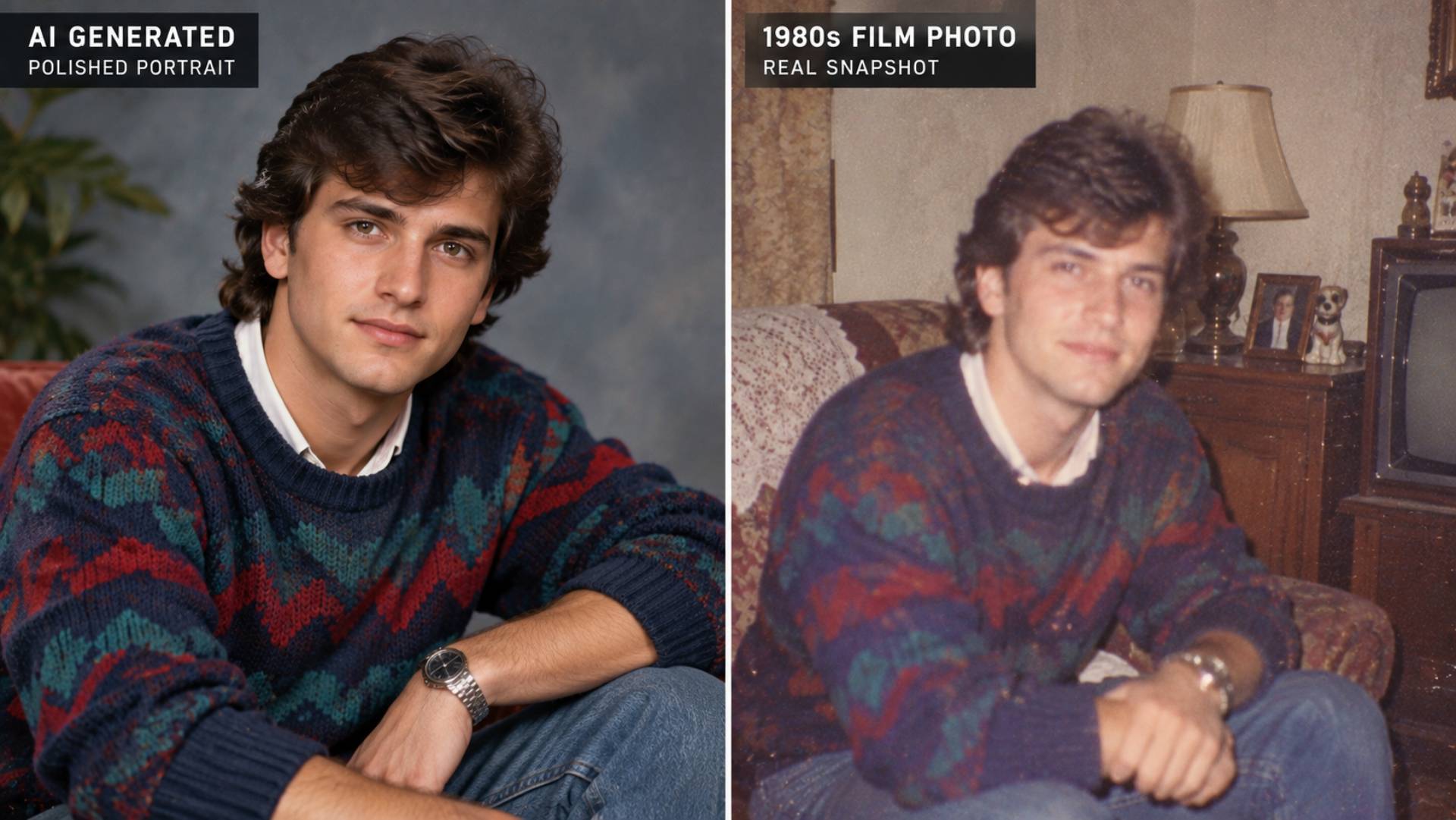
If you have a genuine family photograph, examine it before writing the prompt.
Look at the clothes, but also study the less obvious details: plug sockets, curtains, road markings, packaging, furniture, hairstyles, spectacles and the way people stand. Notice whether the picture was taken professionally or casually. Check what appears old even within the photograph’s own period.
Then use the original as a reference without asking AI to “improve” it. Improvement often means modern beauty standards, smoother skin, luxury clothing and cinematic light. Ask instead for historical consistency and preservation of identity.
When the new version is complete, compare it with the source:
- Does the person still look like themselves?
- Do the clothes belong to the stated year and occasion?
- Is the location regionally convincing?
- Are there too many nostalgic objects?
- Does the photographic quality fit the camera and setting?
- Has the tool made ordinary life unrealistically glamorous?
- Could viewers mistake the generated scene for a real historical record?
That final question determines whether the image needs a clear AI label.
The AI Version Is Nostalgia, Not Evidence
An AI-generated photograph can feel familiar even when the event never happened. Its faded colours and period details give it the visual authority of an archive.
That makes labelling important. A fictional picture of an ordinary imagined scene may cause little confusion, but an image involving a public figure, political event, protest, disaster or supposed historical moment can mislead people quickly.
Users should also obtain permission before uploading somebody else’s face and take particular care with photographs of children. The current privacy and commercial-use terms of the chosen platform should be checked before images are uploaded or published.
AI can interpret the past. It should not quietly rewrite it.
Frequently Asked Questions
What did Britain really look like in the 1980s?
There was no single look. Britain included fashionable city centres, industrial communities, suburbs, rural areas and coastal towns. Everyday interiors and clothing were generally more restrained and mixed in age than AI images suggest.
Why does AI make the 1980s look neon?
Neon colour, synth-pop imagery and dramatic nightlife photography are easy visual signals for the decade. AI tends to emphasise recognisable symbols even though they did not dominate ordinary daily life.
Were British homes really brown and floral?
Many contained brown, beige, cream and floral furnishings, but homes varied widely. Furniture and decoration from earlier decades often remained in use, creating a mix rather than a perfectly coordinated 1980s style.
How can I make a British 1980s AI portrait look realistic?
Choose an exact year, location and occasion. Describe ordinary clothing, use only a few period objects and request consumer-film photography rather than cinematic lighting.
Should an AI-generated retro photograph be labelled?
Yes, when viewers might reasonably believe it is an authentic photograph. Labelling is particularly important for public figures and apparent historical events.
Can AI accurately recreate my family’s past?
AI can create a plausible interpretation, but it cannot recover an event that was never photographed. Treat the result as an imagined reconstruction, not a historical record.
The Real 1980s Were Less Perfect and More Interesting
AI gives Britain’s 1980s a stylish makeover. It concentrates the decade into its loudest clothes, most famous gadgets and most recognisable colours. The results can be inventive, entertaining and occasionally beautiful.
But real British life was not a permanent music video. It was school uniforms under winter coats, old furniture beside new technology, cloudy seaside holidays, local high streets and family photographs that were treasured despite their flaws.
The most convincing AI images do not simply add more retro objects. They leave space for ordinary life. They recognise regional differences, mix old and new belongings and allow the photograph to remain slightly imperfect.
That is where the real British 1980s becomes more compelling than the machine-made version. The decade’s character was not created by neon alone. It came from the contradictions, limitations and everyday details that people actually lived.