


































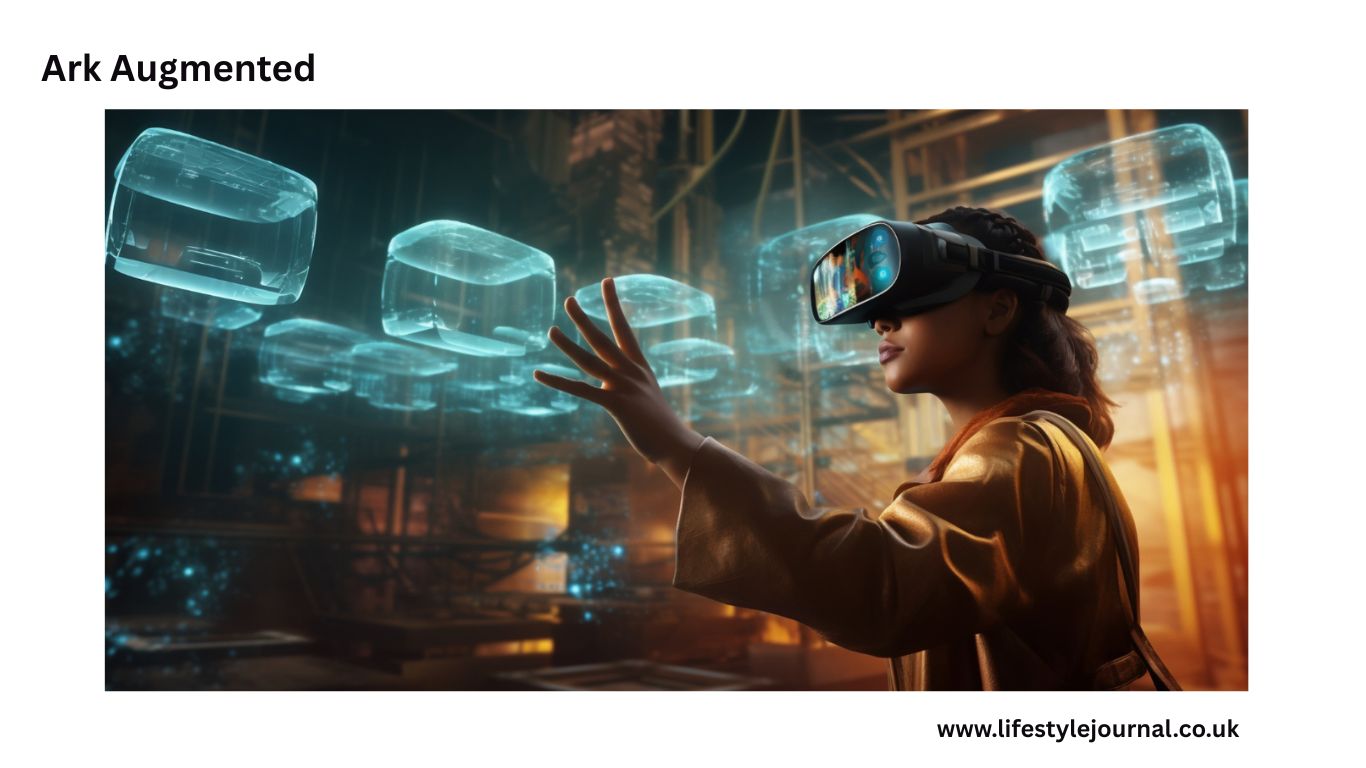
Do you think we could enter a universe where the digital and the real become one, and we could touch virtual things like they were real? This isn’t science fiction anymore. It’s what ARK’s new augmented reality technology promises. The new ARK (Augmented Reality Kiosk) system from the Computer Graphics Centre in Portugal is a big step forward in the field of interactive technology. It shows that you don’t need to have the latest high-tech helmets to make great augmented reality experiences.
The ARK system is more than just another AR prototype; it’s a proof-of-concept technology that could make AR available to more people at much lower costs and with less complexity. ARK uses a regular 21-inch monitor and smart designs to creatively solve one of the main problems in AR: the occlusion problem, which happens when physical items get in the way of virtual screens.
Ark Augmented Reality: The Basics
Ark adds to simple overlays by mixing knowledge, memory, adaptation, emergent behavior, and participatory scene creation. It’s able to sense where it is, make changes on the spot, and communicate through pictures, sound, or feedback. This makes Ark augmented reality examples more personal and active.
- Knowledge memory in AR: using past contacts or external knowledge bases, like knowledge graphs and large language models, which are so big they can mimic human writing. So that the system can “remember” styles, likes, or the setting in which it is used.
- Interactive emergent ability: the ability to come up with new, useful responses or material in settings that you haven’t specifically coded. For example, changing the layout of virtual furniture based on a room’s lighting and what’s in the way.
- Augmented reality scene generation: making or changing 2D or 3D scenes on the fly, even in real or virtual settings that aren’t currently being shown.
- App Architecture: Ark’s augmented reality app designs often use cross-modality input (speech, motion, location) and tracking in real time.
The Basic Technology
ARK’s hardware proves that the most effective AR could work with a simple setup, even though it’s not the most expensive part of the system:
This simple-looking tech setup does something very impressive. It makes an AR setting that users can naturally move through with their hands in both the real and virtual worlds while they see a normal image on a screen.
The U.S. Market Size, Trends, and Investment
To understand where Ark augmented reality fits in, we need to look at the bigger interactive tech and AR/VR markets, especially in the U.S.
The U.S. market for interactive technologies like augmented reality (AR), virtual reality (VR), and mixed reality (MR) was worth about $11.2 billion in 2023. From 2024 to 2030, it should grow about 23.9% every year.
In 2024, the worldwide market for AR was worth roughly $93.67 billion. North America had the biggest share. By 2032, the AR market in the United States will probably be worth about $342.73 billion.
Analysts expect that many people will be interested in investing in immersive technologies, especially companies that use AR/VR for training, shopping, design, healthcare, and entertainment. Ark’s advanced features put it in a good situation to do well.
So, when U.S. investors, tech companies, startups, and public organizations are constantly putting more money and study into new technologies, interactive experiences, and next-generation content, Ark augmented reality comes onto the scene.
Interactive Technology That Can Learn New Things
Huang et al. (2023) The ArK Model
- The study Ark: Knowledge-Interactive Emergent Ability and Augmented Reality lays out a plan for how ARK augmented reality might work in real life. Important things to remember:
- For scene understanding and scene generation or changing that it hasn’t done before, it relies on knowledge memory from both foundational models and external sources.
- It shows that when Ark augmented reality is used in new actual places, it can create better 2D and 3D scenes than basic AR or VR models.
- It stresses the value of collecting contextual clues across different modalities (like sight, text, and sound) and of human-AI contact.
Real-World Use in the U.S.
Here are some examples of ARK augmented reality that are either already in use or will be in the near future. They are all based on real-life situations or possible uses in the United States:
- Wearable AR technology: smart glasses or mixed-reality tools that make augmented reality (ARK) possible. This lets users see content that changes based on the environment, like historical information in heritage zones or alerts in industrial settings.
- Architecture and urban planning: Local governments are using augmented reality for public meetings to get input. Ark could make it possible to change shadow projects and styles on the fly and add community feedback to suggested buildings.
- Education: Now that Ark augmented reality has come to the US, students can use apps to learn that adapt to what they already know, react to their environment, and move at a pace that works for their learning style.
- Retail and marketing: Brands use AR apps to help people who are shopping and with marketing. The tools suggest lighting, room shapes, arrangement, and colors.
- Entertainment and streaming: how Ark works with movie streaming providers. Imagine a movie where you can interact with actors or items that appear in your room through a blend of reality and technology.
Ark: Ethical and Technical Limits of Augmented Reality
There are big problems that come with making Ark augmented reality a reality:
- Computers and hardware: It takes a lot to run Ark augmented reality in real time. Scene creation and making smooth, immersive experiences requires strong processors, dependable systems, and high-quality hardware.
- Latency, tracking, and changes: These are big problems in the world. It’s hard to make sure that virtual content can be used in real places without any issues, even when the lighting changes, new things get in the way, or the settings are unpredictable.
- Content creation burden: The hard work of making models, writing, images, and other things that are made for different situations.
Teaching computers to recognize context and style
- Privacy, security, and bias: Knowledge memory might store things like user preferences and location data. People are worried about who owns 3D scans of private areas and whether the algorithms might be biased.
- ARK fills a unique role by offering the security and visual quality of fixed systems with the cost-effectiveness and ease of use in a truly exceptional way. The Virtual Showcase system that it was based on made people just look at things. This one is different because it lets users interact with items.
Ark Augmented Reality Market Trends and Growth
The U.S. interactive technology market was worth about $11.2 billion from 2023 to 2025 and will probably grow by almost 24% a year until 2030. Ark augmented reality is ready to take a bigger part of this growth, especially in the business, education, and public sectors.
The AR-only market is as big as the ARK in North America. People and companies will both be more likely to spend money on gear, apps, and wearables. A lot of money has already gone into AR/VR stocks, devices, and software, but Ark augmented reality stands out as a truly disruptive innovation. This will likely draw in new research and development as well as startup capital, especially in the area of AI and AR combined.
It’s still hard for standard AR scene generation to work in new settings, but Ark augmented reality can create and change scenes in spaces it has never seen before, which could help get around these issues. And even though smart glasses, headsets, and other AR technology that you wear have been slow to catch on because of cost and comfort, changes in devices and the rise of AR apps could finally make wearables popular with both consumers and
What is going to happen with immersive technology?
Here are some places in the US where Ark Augmented Reality is expected to grow and have an impact on the future of interactive technology.
- Joining with streaming and video services: Ark and video streaming services will become one.
- Remote and Hybrid work: Ark augmented reality will make virtual meeting rooms that combine backgrounds, shared holograms, real places, and memories of the people who work together. This technology will react to the surroundings and what the user tells it to do.
- Health, accessibility, and training: Ark’s augmented reality can change pictures depending on a person’s learning background or sensory needs. This will help medical training, emergency reaction, therapy, and teaching tools.
- Fashion and consumer wearables: smart contact lenses, AR glasses, and clothing that uses AR for fashion, usefulness, or show purposes; augmented reality (ARK) will need wearable tech that helps with memory and scene creation.
Ark Augmented Reality’s Next Steps in the United States
- To be able to use the possible benefits of Ark augmented reality, people in the U.S., including businesses, teachers, or the government, should do the following:
- Pay close attention to changes in interactive technology, especially those related to how scenes are created, how information is remembered, and how new behaviors come about.
- Look at the norms and policy guidelines for public safety, privacy, permission, and signage. This builds trust in ARK augmented reality and VR virtual reality interactions.
- Make cheap, practical, and available wearable AR technology a top priority.
Also, look at how ARK’s pilot projects used augmented reality in public planning, health, education, and heritage protection to show that it works in real-life situations in the United States.
Common Questions
How is Ark augmented reality different from regular AR?
Standard AR adds pictures or graphics to the real world, like filters, signs, or static models. It doesn’t change much depending on where you are. The Ark augmented reality drawing on studies like ArK with Knowledge Interactive Emergent Ability, on the other hand, adds knowledge, memory, and interactive emergent ability. This lets it create dynamic scenes in environments it has never been in before and change the content based on what it “learns” from its surroundings.
Can Ark augmented reality be used without complex models or methods that are hard to use?
Ark’s augmented reality has many advanced features, like scene generation in new places, knowledge memory, and spontaneous behavior. These are possible because of base models and strong systems. But some U.S. AR apps already do parts of this: developers can make simpler versions of ARK by focusing on easier rules, environment models that are already encoded, or limited interaction.
Are there already cases of ARK augmented reality apps in the U.S.?
There are strong cases of Ark augmented reality, but not many full ones yet. The ARK with Knowledge Interactive Emergent Ability study, on the other hand, shows what app or system features might be available in the future.
How is Ark’s augmented reality like or different from VR or mixed reality (MR)?
Ark augmented reality is more like AR and MR (mixed reality) than VR (virtual reality). Augmented reality (AR) adds digital things to the real world, but mixed reality (MR) is even more advanced because it lets those digital things interact with the real world around them.
What are the ethics and private problems with using Ark?
Ark augmented reality includes knowledge memory, which means that it can store and remember information about the person or the context of the situation. It also includes image scanning and probably the ability to constantly see what’s going on in different places.