


































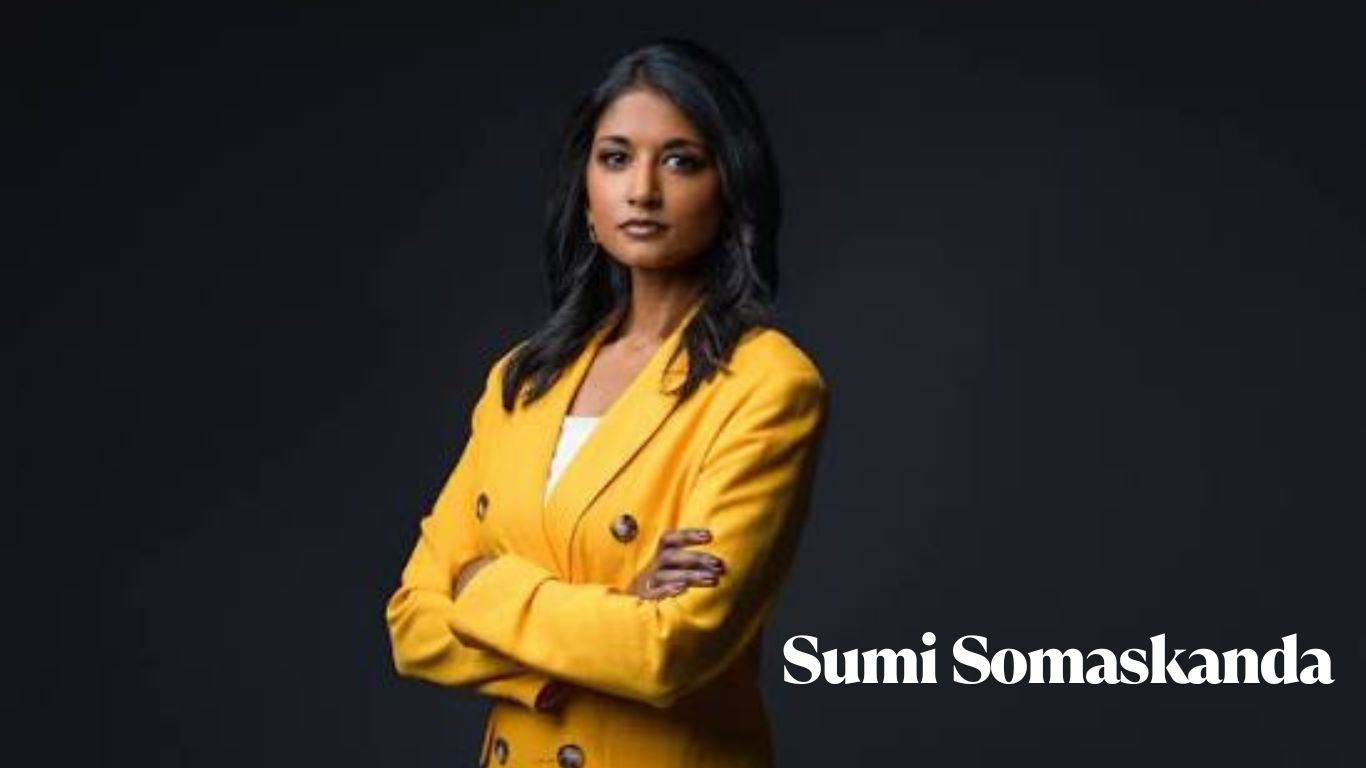
The area between nations, languages, and political systems is where Sumi Somaskanda developed her career. She is a well-known figure to many viewers on BBC News, where she anchors from Washington, D.C. Her cool demeanour is appropriate for breaking news, elections, conflicts, and diplomatic crises. However, her career did not start on a worldwide scale and did not follow the path of a TV celebrity seeking attention. It developed via years of explaining American and European politics to audiences far beyond one nation, as well as through reporting, writing, producing, and editing.
Somaskanda is intriguing because of this. She is not a famous journalist whose public persona revolves around her personal life. As the BBC established its U.S. news operation and put her in front of significant worldwide topics, she is a working international broadcaster whose name has become increasingly frequently sought. The job itself—the newsrooms, reporting beats, languages, issues she returned to, and the professional reputation that propelled her from Berlin to Washington—is the best way to understand her biography.
Meet Sumi Somaskanda
Sumi Somaskanda is an American journalist, television presenter, writer and editor who has built a respected career covering some of the world’s biggest political and international stories. As a BBC News chief presenter based in Washington, D.C., she helps audiences understand major global events, from U.S. elections to international conflicts and diplomatic developments.
Before joining the BBC, Somaskanda spent more than a decade in Berlin working with Deutsche Welle (DW), Germany’s international broadcaster. Throughout her career, she has worked across television, print journalism, podcasts, radio and live public events, making her one of the few journalists with experience in almost every major form of news reporting.
Rather than becoming known for one viral interview or headline-making moment, Somaskanda has earned recognition through years of thoughtful reporting. Her work focuses on politics, democracy, migration, cybersecurity, misinformation and international affairs, subjects that demand careful reporting and balanced analysis.
Today, she is regarded as one of the BBC’s trusted international presenters, helping viewers make sense of complex stories affecting audiences around the world.
Early Life and Cultural Background
Unlike many public figures, Sumi Somaskanda has chosen to keep her personal life away from the spotlight. While she regularly appears on television, very little verified information has been shared about her childhood, parents or family life.
Most of her public biographies concentrate on her journalism career rather than her personal background, making it difficult to confirm many details about her early years.
One aspect of her background that is publicly known is her multilingual ability. Alongside English, Somaskanda speaks fluent German and Spanish, while also having conversational knowledge of Tamil. These language skills have been valuable throughout her international reporting career, allowing her to communicate across cultures and engage with a wide variety of sources.
Her professional journey also reflects a truly global outlook. Having worked extensively in both the United States and Europe, she has developed a broad understanding of political systems, international relations and cultural differences that continues to shape her reporting today.
Education and Journalism Training
Sumi Somaskanda studied journalism at the renowned Medill School of Journalism at Northwestern University in the United States. The school has produced many respected journalists and is recognised for combining practical newsroom experience with strong reporting fundamentals.
Her education provided a solid foundation in news writing, investigative reporting, interviewing techniques and broadcast journalism.
Like many successful journalists, Somaskanda did not begin her career in a high-profile television role. Instead, she gradually developed her skills by working across different areas of journalism, gaining valuable experience before moving into international broadcasting.
This steady career progression helped her build a strong editorial foundation that continues to influence her work today.
Starting Out in Journalism
Somaskanda’s early professional experience included work with local and regional media organisations in the United States. During these years she worked in several newsroom roles, including reporting, producing, writing and presenting.
These early positions allowed her to cover a wide range of everyday stories while learning how newsrooms operate under tight deadlines.
Local journalism often requires reporters to switch quickly between subjects, interview people from different backgrounds and explain complicated issues in simple language. Those experiences helped develop the clear communication style that has become one of Somaskanda’s strengths.
Behind the scenes, she also gained valuable experience as a producer.
Although producers rarely appear on camera, they play an essential role in planning broadcasts, verifying information, coordinating interviews and ensuring programmes run smoothly. This production experience gave Somaskanda a deeper understanding of how quality journalism is created long before viewers see it on screen.
A Career Across Multiple Forms of Media
One of the defining features of Sumi Somaskanda’s career is her versatility.
Instead of focusing solely on television, she has successfully worked as a journalist, presenter, editor, writer, producer, podcast host and public moderator.
Each role has strengthened the others.
Her writing developed her ability to explain complex issues clearly. Producing sharpened her editorial judgement and organisational skills. Television presenting strengthened her confidence in live broadcasting, while moderating public discussions helped her communicate with experts, policymakers and audiences alike.
This broad experience has enabled her to move comfortably between breaking news coverage, long-form analysis and public conversations without losing sight of the facts.
Reporting on Politics and International Affairs
Throughout her career, Somaskanda has focused on stories that shape governments, societies and international relations.
Her reporting has covered subjects including:
- Elections and democratic institutions
- Immigration and refugee policy
- Cybersecurity and digital threats
- Disinformation and media trust
- European politics
- Economic challenges
- International diplomacy
- Social change and public policy
These topics often require more than simply reporting daily events.
They demand historical context, careful research and the ability to explain why political decisions affect ordinary people.
Somaskanda has built a reputation for presenting these issues in a way that remains informative without becoming overly complicated.
Building an International Reputation
As her career progressed, Somaskanda’s work expanded beyond domestic reporting into international journalism.
Her articles appeared in several respected publications covering foreign affairs, politics and global developments. Through both television and written journalism, she explored subjects including migration, democratic institutions, extremism, economic inequality and changing political landscapes across Europe.
This international focus helped establish her reputation as a journalist capable of explaining complex global issues to audiences from different countries.
Rather than concentrating only on breaking news, she often explored the wider forces driving political change, helping readers understand how events in one country could influence developments elsewhere.
That ability to connect local events with international consequences would later become one of her greatest strengths as an international broadcaster.
Berlin: A Defining Chapter in Her Career
One of the most significant periods of Somaskanda’s professional journey began when she moved to Berlin.
She spent approximately 14 years in the German capital during a period of enormous political and social change across Europe.
During those years, Germany became central to many of the continent’s biggest stories, including the Eurozone financial crisis, the refugee crisis, debates surrounding immigration, rising political extremism and increasing concerns over cybersecurity.
Working in Berlin placed Somaskanda at the centre of these developments.
It also gave her firsthand experience reporting on stories that attracted worldwide attention, preparing her for a much larger international audience in the years ahead.
By covering these major events on the ground, she developed the balanced reporting style and international perspective that continue to define her journalism today.
Deutsche Welle: Establishing an International Presence
Sumi Somaskanda’s move to Deutsche Welle (DW) marked a major turning point in her journalism career. Based in Berlin, she spent more than a decade working as a senior presenter and correspondent for Germany’s international broadcaster, delivering news to audiences across the globe.
Unlike national broadcasters that primarily focus on domestic viewers, DW serves an international audience. This meant Somaskanda’s role went beyond reporting events—she also needed to explain why those events mattered to people living in different parts of the world.
Whether covering political developments in Europe or major international crises, her reporting consistently aimed to provide context alongside the headlines.
During her time at DW, she became a familiar face on English-language news programmes, presenting live coverage, conducting interviews and reporting on some of Europe’s most significant political developments.
Reporting During a Transformative Period in Europe
Berlin became an ideal base for an international journalist.
While Somaskanda was working there, Europe experienced a series of historic events that reshaped politics across the continent.
She reported during a period that included:
- The European debt crisis
- Germany’s refugee and asylum debates
- The rise of populist political movements
- Increasing tensions between Russia and the West
- Growing concerns around cybersecurity
- Questions surrounding democracy and public trust
These stories were often interconnected, affecting not only Europe but also international relations and global policy.
Covering these issues required careful reporting, as many involved sensitive political debates and deeply divided public opinion.
Rather than focusing on dramatic headlines, Somaskanda’s reporting aimed to help viewers understand the wider picture behind each development.
Covering Migration and Social Change
One of the defining topics of her years in Germany was migration.
As Europe faced one of its largest refugee movements in recent history, Germany became a central focus of international attention. The country’s immigration policies sparked debate across Europe and influenced elections, public opinion, and government policy.
Somaskanda reported on these developments from multiple perspectives.
Her work explored how migration affected communities, public services, national politics, and international relations. Instead of reducing the issue to numbers or political slogans, her reporting often highlighted the human experiences behind policy decisions.
This balanced approach allowed audiences to better understand the complexity of one of Europe’s most significant political challenges.
Examining Democracy and Political Change
Throughout her reporting career, democracy has remained one of Somaskanda’s central areas of interest.
She has covered elections, political reform, public trust in institutions, and the growing challenges faced by democratic governments around the world.
While reporting from Germany, she closely followed the emergence of far-right political parties and changing voter behaviour. She also examined the social and economic factors influencing political attitudes, particularly in regions experiencing economic uncertainty or rapid demographic change.
Her reporting frequently explored questions such as the following:
- Why do voters lose trust in political institutions?
- How does misinformation influence elections?
- What impact does economic inequality have on democracy?
- Why are extremist movements gaining support in some regions?
These themes later became equally relevant in her coverage of American politics.
A Strong Voice in International Journalism
Television has been only one part of Somaskanda’s professional career.
Alongside broadcasting, she has written extensively for several internationally recognised publications, contributing analysis and feature articles on politics, foreign affairs and international issues.
Her work has appeared in publications, including:
- The Atlantic
- Foreign Policy
- The Washington Post
- Al Jazeera
- Newsweek
- USA Today
- PRI
- GlobalPost
Writing for these publications allowed her to explore stories in greater depth than television broadcasts typically allow.
Long-form journalism gave her the opportunity to explain political developments, historical context and international relationships with greater detail while maintaining the factual accuracy expected from a professional journalist.
Writing About Trust, Technology and Modern Politics
As global politics became increasingly influenced by technology, Somaskanda’s reporting expanded to include subjects such as misinformation, cyber threats and the changing relationship between governments, media and the public.
These issues have become some of the defining challenges facing modern journalism.
Her work examined how false information spreads online, how digital platforms influence public debate and why trust in traditional institutions has declined in many countries.
By exploring these subjects through both written journalism and television reporting, she helped audiences understand how technology continues to reshape politics and democratic societies.
Beyond Television: Editing and Podcasting
Somaskanda’s career has extended well beyond presenting the news.
She has also worked as an editor, helping shape political analysis and long-form journalism before publication. Editorial work requires careful judgement, ensuring stories are accurate, balanced and clearly structured.
In addition, she hosted Studio Berlin, a current affairs podcast that explored politics, international relations and European affairs through longer conversations with experts and policymakers.
Podcasting allowed her to discuss complex subjects in greater depth than a traditional television bulletin, giving audiences additional insight into issues affecting Europe and the wider world.
These experiences further strengthened her ability to communicate across multiple platforms.
Moderating Global Conversations
Alongside journalism, Somaskanda has regularly moderated conferences, public discussions and international policy events.
These appearances brought together government officials, academics, business leaders and policy experts to discuss topics including:
- International trade
- Democracy
- Artificial intelligence
- Misinformation
- Migration
- Economic policy
- Global security
Moderating such discussions requires different skills from television presenting.
Instead of simply reporting events, moderators guide conversations, ask thoughtful questions and encourage meaningful debate while remaining impartial.
This aspect of her career reflects the confidence many organisations have placed in her professionalism and subject knowledge.
Joining BBC News
After building an impressive international career in Berlin, Somaskanda joined BBC News in 2023 as a chief presenter.
The appointment formed part of the BBC’s expansion of its international news operation in Washington, D.C., reflecting the broadcaster’s growing investment in American political coverage.
The move represented a natural progression in her career.
She arrived with years of experience reporting on European politics, international affairs and democratic institutions, bringing valuable global perspective to the BBC’s expanding U.S. newsroom.
Working from Washington also positioned her close to many of the world’s most important political developments.
As international audiences increasingly look to the United States for news affecting diplomacy, trade, security and global markets, her role became even more significant.
Becoming One of the BBC’s Trusted Presenters
Joining the BBC meant stepping into one of the world’s most recognised news organisations.
As a chief presenter, Somaskanda is responsible for far more than reading headlines.
Her role includes preparing for interviews, understanding complex political developments, working closely with editorial teams and guiding viewers through breaking news as events unfold.
International broadcasting often requires presenting stories before every detail has been confirmed.
In these situations, accuracy, calm decision-making and careful language become essential.
Somaskanda’s years of experience at Deutsche Welle prepared her well for these challenges.
Her measured delivery, strong editorial judgement and deep understanding of international affairs have helped establish her as one of the BBC’s respected global presenters.
Reporting from Washington, D.C.
Since joining BBC News, Sumi Somaskanda has been based in Washington, D.C., one of the world’s most influential political capitals. From there, she reports on major American and international developments for a global audience.
Her position allows her to cover stories that reach far beyond U.S. borders. Decisions made in Washington often shape international diplomacy, defence, trade, climate policy and global markets, making her reporting relevant to viewers around the world.
Rather than reporting solely for an American audience, Somaskanda explains U.S. political developments in a way that viewers from Europe, Asia, Africa and elsewhere can easily understand.
Covering U.S. Elections and Global Politics
One of Somaskanda’s most visible responsibilities has been reporting on American elections and political affairs.
During the 2024 election cycle, she was among the BBC presenters delivering live coverage, election analysis and interviews across television, digital platforms and audio programming.
Her reporting has gone beyond campaign speeches and political debates. She has travelled to communities, spoken with voters and explored the issues shaping public opinion, including:
- The economy
- Immigration
- Healthcare
- Foreign policy
- National security
- Democracy and voting rights
By combining on-the-ground reporting with political analysis, she helps audiences understand not only what is happening, but why it matters.
A Calm and Trusted On-Air Presence
Sumi Somaskanda has developed a presentation style that reflects professionalism rather than personality-driven broadcasting.
She is known for delivering the news with clarity, composure and careful attention to facts. Even during major breaking stories, her approach remains measured and informative.
Unlike many modern television personalities who build large public profiles through social media or personal branding, Somaskanda keeps the focus firmly on journalism.
Her role is to guide viewers through developing events rather than become the centre of attention herself.
This approach aligns closely with the traditions of international public service broadcasting, where credibility and accuracy remain the highest priorities.
Keeping Her Personal Life Private
Although she appears regularly on television, Sumi Somaskanda has shared very little about her personal life.
There is no publicly verified information confirming details about her marriage, husband or long-term relationship. Likewise, reliable sources have not confirmed whether she has children.
While some websites publish personal claims about public figures, many of these lack credible evidence. Responsible biographies should rely only on information that has been confirmed through trustworthy sources.
Somaskanda has consistently maintained a clear separation between her professional work and her private life, allowing her journalism to remain the focus of public attention.
Income, Salary and Net Worth
As with many journalists working for major international broadcasters, Sumi Somaskanda’s salary has not been publicly disclosed.
For this reason, no verified estimate of her net worth is available.
Although various websites publish financial figures, these are generally speculative and unsupported by official information.
Her career suggests that her primary sources of income have included:
- Television broadcasting
- Journalism and reporting
- Writing for international publications
- Editing
- Podcast hosting
- Moderating conferences and public events
- Guest speaking and professional engagements
Without official financial records, assigning an exact net worth would be inaccurate. What is publicly clear is that she has established herself as a senior journalist within one of the world’s leading news organisations.
Professional Recognition
Throughout her career, Somaskanda has earned respect through the quality of her journalism rather than through celebrity status.
In addition to her work on television, she has been invited to moderate international conferences and policy discussions involving political leaders, academics and industry experts.
These invitations demonstrate the confidence organisations place in her ability to lead thoughtful discussions on complex global issues.
Her appointments at both Deutsche Welle and BBC News also reflect significant professional achievement.
Senior presenting roles at internationally recognised broadcasters require years of editorial experience, strong live broadcasting skills and the ability to report fairly on sensitive global events.
Has Sumi Somaskanda Faced Any Controversies?
Based on the available public record, Sumi Somaskanda has not been associated with any major personal controversies or public scandals.
Like many journalists covering politics, elections and international affairs, she occasionally reports on topics that generate strong public opinions.
Political journalism often attracts criticism from audiences with differing viewpoints, particularly during election periods or major global events.
However, there is no well-documented controversy that defines her professional reputation.
Instead, she is generally recognised for maintaining a balanced, factual and measured approach to reporting.
Where Is Sumi Somaskanda Today?
Today, Sumi Somaskanda continues to serve as a BBC News chief presenter based in Washington, D.C.
She remains actively involved in reporting on American politics, international relations and breaking global news for viewers around the world.
As journalism continues to evolve across television, digital media, podcasts and live events, Somaskanda has successfully adapted to multiple platforms while maintaining the same commitment to accurate and thoughtful reporting.
With experience spanning the United States and Europe, she has become one of the BBC’s trusted voices for explaining international stories that shape today’s world.
Frequently Asked Questions
Sumi Somaskanda is who?
American journalist Sumi Somaskanda is a writer, editor, and main presenter for BBC News. She covers worldwide news, American politics, and significant world events from her headquarters in Washington, D.C. She worked for Deutsche Welle in Germany for many years as a senior presenter and journalist before joining the BBC.
What is the nationality of Sumi Somaskanda?
The American is Sumi Somaskanda. However, her journalism career has been very global, with a great deal of experience covering stories for audiences worldwide from Germany and the United States.
Before joining BBC News, where did Sumi Somaskanda work?
She was employed by Germany’s worldwide public broadcaster, Deutsche Welle (DW), prior to joining BBC News. She also worked as a reporter, producer, and presenter in local and regional American media earlier in her career.
Does Sumi Somaskanda have a spouse?
Sumi Somaskanda’s marital status is not confirmed by any publicly available information. She has made the decision to keep her personal relationships private, and no trustworthy public source offers verified information.
Is Sumi Somaskanda a parent?
The existence of children by Sumi Somaskanda has not been verified by credible public sources. Her family life has always remained private.
What is the net worth of Sumi Somaskanda?
Sumi Somaskanda’s net worth has not been confirmed by the public. Online figures should be regarded as conjecture until they are backed up by official data.
Which languages is Sumi Somaskanda able to speak?
Professional profiles indicate that Sumi Somaskanda is fluent in Spanish, German, and English. In keeping with her eclectic upbringing and global work, she also speaks Tamil fluently.
Final Thoughts
Sumi Somaskanda has built a journalism career through experience, consistency and international reporting rather than public attention or celebrity.
From her early work in American newsrooms to more than a decade covering European affairs in Berlin, and now as a BBC News chief presenter in Washington, she has steadily developed a reputation for explaining complex global issues with clarity and balance.
Her work spans politics, democracy, migration, cybersecurity and international relations—subjects that continue to shape headlines around the world. By working across television, print, podcasts and live events, she has demonstrated the adaptability required in modern journalism while maintaining high editorial standards.
Although she keeps her personal life private, her professional achievements speak for themselves. As global audiences continue to seek reliable news in an increasingly complex world, Sumi Somaskanda remains one of the trusted journalists helping viewers understand the stories that matter most.