





























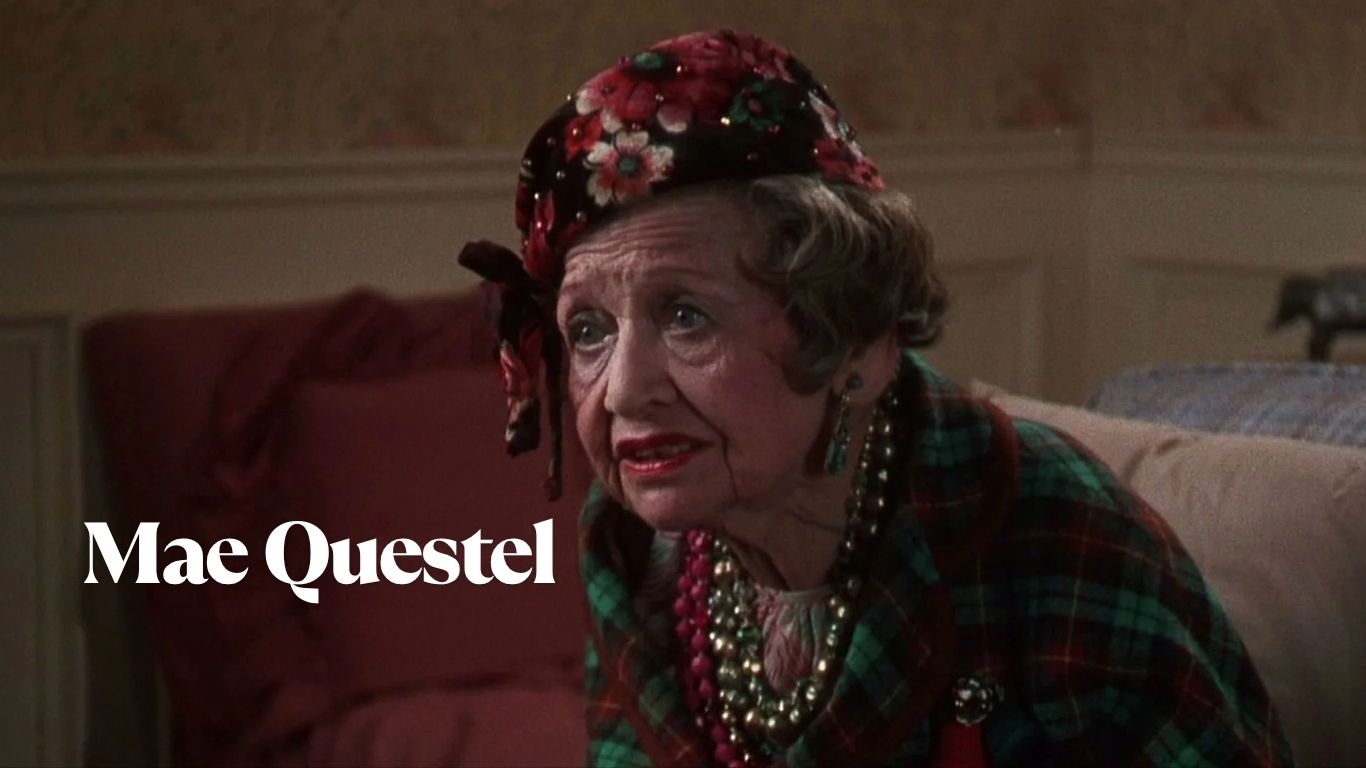
Born on September 13, 1908, Mae Questel was an American voice actor best known for providing the voices of Olive Oyl and Betty Boop in over 150 animated shorts.
She was a real voice actor pioneer. Questel worked in Hollywood movies, animation studios, and vaudeville stages during the course of a 60-year career. At the age of 89, she passed away on January 4, 1998, leaving a legacy that continues to influence animation to this day.
Mae Questel: Who Was She?
One of the most significant voice actors in the history of animation is Mae Questel. Beginning in 1931, she created Betty Boop, a figure that went on to become a global icon in popular culture. Long before they knew her name, the majority of people heard her voice.
Simon Kwestel and Frieda Glauberman welcomed Mae Kwestel into the world in the Bronx, New York. Her Orthodox Jewish family constantly prevented her from pursuing a career in entertainment. They even drafted their wills in an attempt to intimidate her into not acting, but it was unsuccessful.
When Mae was younger, she had extraordinary talent. She was fluent in Spanish, Polish, German, and French. She received a Spanish school prize. She began acting in vaudeville at the age of 17.
The Age and Early Life of Mae Questel
When Mae Questel passed away, what was her age?
When Mae Questel passed away on January 4, 1998, she was 89 years old.
She was raised in the early 20th century in the South Bronx. In 1925, at the age of 17, she participated in and won a local talent competition at the RKO Fordham Theater. The goal of the competition was to find the girl who most closely resembled Helen Kane, the well-known “Boop-Oop-A-Doop Queen.” Her career began after she won that competition.
Important early benchmarks:
- 1908: Born in the Bronx, New York, Mae Kwestel
- 1925 — Won the RKO Fordham Theater’s Helen Kane mimicry competition
- 1925–1930: Performed as “Mae Questel, Personality Singer of Personality Songs” on the vaudeville circuit.
- Max Fleischer hired him in 1931 to provide the voice of Betty Boop.
- studied acting in New York City at the Theater Guild and the American Theater Wing.
- studied drama at Columbia University as well.
The Height and Physical Character of Mae Questel
Mae Questel was around 5 feet 2 inches (157 cm) tall. Because of her small appearance, people who met her in person were even more impressed by her extravagant vocal performances.
Her hair was auburn, or reddish-brown, and her eyes were blue. It was also said that she had a withered arm. To hide this, filmmakers usually took pictures of her with her hands at her waist and her elbows bent during on-camera film appearances. She was never slowed down by it.
The Career of Mae Questel:
The plot becomes intriguing at this point. Mae Questel created her career path block by brick rather than merely falling into animation by accident.
The Years of Vaudeville (1925–1931)
Mae started out on the vaudeville stage as a vocal impressionist. Among her impersonations were:
- Chevalier, Maurice
- Cantor, Eddie
- Brice, Fanny
- Mae West and Marlene Dietrich
- Kane, Helen
She has a remarkable ability to mimic. For radio programs, she also supplied the noises of ducks, dogs, chickens, owls, monkeys, lions, and babies. She was a one-woman sound studio in every way.
Betty Boop’s voice (1931–1939)
In 1931, Max Fleischer, the creator of Betty Boop, heard Mae’s “boop-oop-a-doop” act. He immediately hired her. The history of animation was altered by that choice.
Highlights of Betty Boop’s career:
- Provided the voice of Betty Boop in over 150 animated shorts.
- During the Great Depression, her recording of “On the Good Ship Lollipop” sold more than two million copies.
- From 1931 to 1939, the character was continuously voiced.
- returned in the 1980s to provide the voice of Betty Boop for brief appearances.
The actress Mae had impersonated to launch her career, Helen Kane, served as the official model for the character. Mae had to be aware of the deep relationship, as stated by animation historian Andrew J. Lederer of Animation World Magazine. That mimicry marked the beginning of her own career.
Work on Stage, Film, and Television
Mae Questel was much more than just a voice. Her career in live-action film was similarly remarkable:
- Broadway: Co-starred with the renowned Chita Rivera in the 1964 musical Bajour
- Film: Starring alongside Barbra Streisand in Funny Girl (1968), Jerry Lewis in It’s Only Money (1962), and Elliott Gould in Move (1970)
Woody Allen participated in the mockumentary Zelig (1983) and played the obnoxious mother in the “Oedipus Wrecks” segment of New York Stories (1989).
Her most cherished live-action part in National Lampoon’s Christmas Vacation (1989) is that of the adorable Aunt Bethany, who presents her cat as a gift.
At the age of 81, she was cast in this legendary movie. Give that some thought.
The City of Indianapolis recognized her in 1968 by holding a special “Mae Questel Day.”
The Net Worth of Mae Questel
- About $1 million was the estimated net worth at the time of death in 1998.
- $2–3 million, adjusted to 2025–2026 values
- Over the course of six decades, she accumulated fortune from a variety of sources:
- Royalties for voice acting in Olive Oyl and Betty Boop cartoons
- Fees for radio and vaudeville performances
Broadway stage shows
Fees for appearances in movies and television shows
Commercial work, such as Scott Paper Towels’ “Aunt Bluebell” persona
She was never a Hollywood A-list star. However, she was an entertainer who regularly worked and made money, and her influence vastly eclipsed her wealth.
- The Personal Life and Husband of Mae Questel
- Mae Questel had two marriages over her lengthy life.
- Leo Balkin’s first marriage
- About 1930, they got married.
Robert and Richard Balkin were the couple’s two sons.
The union ended in divorce.
Historical accounts state that Mae declined a Hollywood contract from Paramount in 1932 because her first husband preferred that she stay in New York.
- Jack E. Shelby’s second marriage
- In 1970, she wed Jack E. Shelby.
- In her later years, Jack accompanied Mae to public occasions and was said to be protective of her.
- Before Mae passed away in 1998, Jack was her predecessor.
- Robert, her son, also passed away before her. Richard, her son, survived her.
Mae mostly kept her private life to herself. Her gift to the world was her public character as the vivacious, squeaky-voiced performer. She has her own private life.
The Legacy of Mae Questel
Betty Boop is still one of the most licensed cartoon characters worldwide as of 2026. The persona that Mae Questel created in 1931 is still used worldwide in pop culture allusions, goods, and commercial campaigns.
Why her legacy lives on:
At a time when cartoon voice acting was done on an as-needed basis, she invented the idea of a devoted “voice actor.”
Nancy Cartwright, Tress MacNeille, June Foray, and other generations of voice actresses were also impacted by her.
Globally, the Betty Boop franchise still brings in a sizable amount of money from licensing.
Every holiday season, her role in National Lampoon’s Christmas Vacation appears on television, introducing her to younger audiences.
Cindy Robinson has been the official voice of Betty Boop since the 2000s. However, Mae Questel is consistently acknowledged by animation historians as the classic Betty Boop voice.
FAQs
Who did Betty Boop’s original voice?
A: The first and most enduring voice of Betty Boop was Mae Questel. Between 1931 and 1939, she provided the voice of the character in approximately 150 animated shorts. In the 1980s, she made a few more special appearances. Cindy Robinson is the official voice at the moment.
How did Mae Questel land the Betty Boop role?
A: Her career in vaudeville began when she won a Helen Kane impersonation competition at the age of 17. After hearing her “boop-oop-a-doop” routine in 1931, cartoonist Max Fleischer immediately hired her. She became linked with Betty Boop for decades because of how well her voice fit the character’s demeanor.
What was Mae Questel’s age at death?
A: Mae Questel passed away on January 4, 1998, at the age of 89. Alzheimer’s illness was the reason of her death. In West Babylon, New York, she was laid to rest at New Montefiore Cemetery.
Did Mae Questel have a spouse?
A: Mae Questel did indeed have two marriages. She has two boys from her first marriage to Leo Balkin. In 1970, following their divorce, she wed Jack E. Shelby. Her spouses both passed away before her.
Apart from Betty Boop, which other characters did Mae Questel voice?
A: From 1933 to 1983, she provided the voice of Swee’Pea, Little Audrey, Olive Oyl, and many more Paramount animation characters. In 1945, she even provided Popeye’s voice. She worked in animation for more than 50 years.
What was Mae Questel’s height?
A: Mae Questel’s height was roughly 5 feet 2 inches (157 cm). Despite her reputation for being small, her voice prowess had a huge influence on the history of animation.
Did Mae Questel make any on-screen appearances in films or television series?
A: Indeed. When she was 81 years old, she played Aunt Bethany in National Lampoon’s Christmas Vacation (1989), which is her most well-known on-screen appearance. She also starred in Broadway’s Bajour (1964), New York Stories (1989), and Funny Girl (1968).
What was the net worth of Mae Questel?
A: Mae Questel’s estimated net worth was $1 million at the time of her death in 1998. That comes to about $2–3 million when adjusted to 2025–2026 prices. Over the course of six decades, voice acting, film, theatrical work, and commercial appearances brought her wealth.
What linguistic abilities did Mae Questel possess?
A: From an early age, Mae Questel was an exceptional linguist. She received a school medal for Spanish and was fluent in French, German, Polish, and Spanish. Her remarkable ear for accents, dialects, and character voices throughout her career was probably influenced by her multilingualism.
What makes Mae Questel significant to the history of animation?
A: During the early years of animation in the 1930s, Mae Questel contributed to the legitimacy of voice acting. She established the benchmark for character voice acting that affected subsequent generations of performers. One of the most well-known vocal performances in animation history is still that of Betty Boop and Olive Oyl.