


































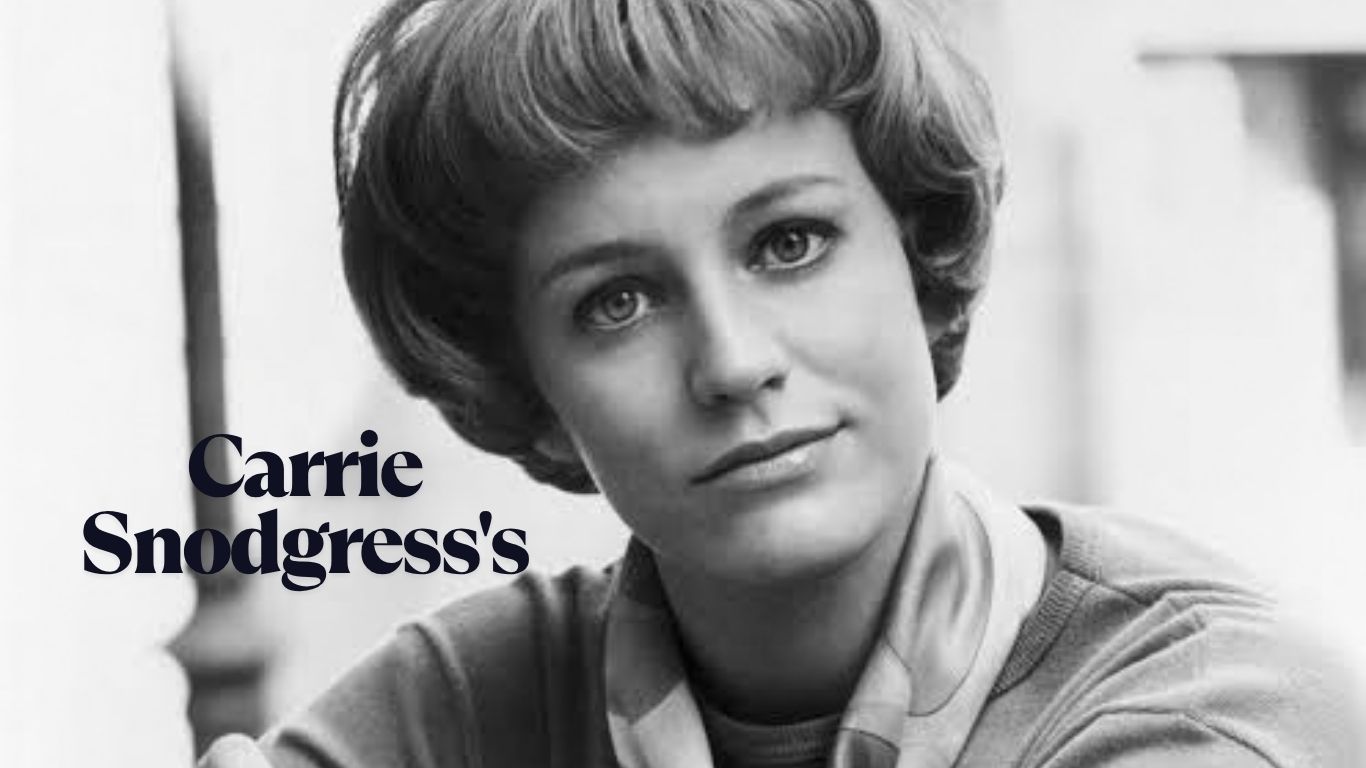
Carrie Snodgress was an American actress best known for her Academy Award-nominated performance in Diary of a Mad Housewife (1970). Born on 27 October 1945, she became one of the most promising performers of the New Hollywood era before stepping away from the spotlight to focus on her family and relationship with musician Neil Young. Snodgress died on 1 April 2004, aged 58, leaving behind a career marked by remarkable talent, personal choices and memorable screen performances.
Carrie Snodgress experienced the kind of early success that many aspiring actors spend their entire careers pursuing. Her breakthrough performance earned critical acclaim and established her as a formidable screen presence. Yet, rather than pursuing stardom at any cost, she made decisions that took her away from Hollywood at a pivotal moment in her career.
Her relationship with Neil Young brought further public attention, while her eventual return to acting demonstrated that her talent extended far beyond a single celebrated performance.
Who Was Carrie Snodgress?
Carrie Snodgress was an American film, television and stage actress whose career gained momentum in the late 1960s and early 1970s. She became widely recognised for portraying Bettina Balser, a frustrated suburban housewife, in Diary of a Mad Housewife.
Born in Barrington, Illinois, on 27 October 1945, Snodgress developed an interest in acting at an early age. She attended Maine Township High School East in Park Ridge before studying at Northern Illinois University. She subsequently trained at the Goodman School of Drama in Chicago, now associated with DePaul University.
Her theatrical education gave her a strong foundation in character development and performance. During her training, she received the Sarah Siddons Award, recognising her achievement as an outstanding graduate.
That preparation proved valuable when she began pursuing professional acting opportunities. Snodgress possessed the technical ability to portray complex emotions without relying on exaggerated gestures or dramatic dialogue. Her performances often drew their strength from subtle expressions and an ability to communicate what a character could not openly say.
Carrie Snodgress’s Early Acting Career
Snodgress began appearing on screen towards the end of the 1960s, a period when American cinema was undergoing significant creative change.
She made an uncredited appearance in Easy Rider (1969), the counterculture film that became a defining work of its era. Her first credited film role followed in Rabbit, Run (1970), which starred James Caan.
Although these early appearances helped establish her professional career, it was her next major role that transformed her prospects.
Diary of a Mad Housewife: The Performance That Changed Everything
Released in 1970, Diary of a Mad Housewife became the defining film of Snodgress’s career. She played Bettina Balser, a woman struggling with an emotionally unsatisfying marriage, domestic expectations and a growing sense of personal frustration.
The character’s circumstances reflected broader conversations about marriage, gender roles and women’s independence during the period. Snodgress portrayed Bettina’s unhappiness with a combination of vulnerability, dry humour and emotional intensity, creating a performance that resonated with audiences and critics.
Her work earned several major honours and nominations:
- Academy Awards: Nominated for Best Actress.
- Golden Globe Awards: Won Best Actress in a Motion Picture – Musical or Comedy and New Star of the Year – Actress.
- BAFTA Awards: Nominated for Most Promising Newcomer to Leading Film Roles.
- Laurel Awards: Received recognition for Best Dramatic Performance by a Female and Star of Tomorrow – Female.
At just 24 years old, Snodgress had established herself as one of the most exciting actresses of her generation.
However, her career did not follow the conventional path expected of an emerging Hollywood star. Personal circumstances would soon influence her professional decisions.
Carrie Snodgress and Neil Young: Inside Their Relationship
Carrie Snodgress’s relationship with Neil Young remains one of the most widely discussed aspects of her life. Their partnership connected an acclaimed actress with a musician whose work would become central to the history of rock music.
Snodgress met Young in the early 1970s, when his career was flourishing following his time with Buffalo Springfield and Crosby, Stills, Nash & Young. The two became domestic partners, and she moved to his ranch in Northern California.
Their son, Zeke Young, was born in 1972. He was born with cerebral palsy, and Snodgress subsequently devoted considerable time to raising him and supporting her family.
The demands of family life coincided with a period when Hollywood might otherwise have offered her further opportunities. Her decision to step away from the screen significantly altered the trajectory of her acting career.
Why Did Carrie Snodgress Step Away From Hollywood?
Snodgress’s reduced screen presence during the 1970s was closely connected to her relationship with Young and her commitment to their son.
For an actress whose breakthrough had brought major awards attention, stepping away from prominent roles represented a significant change. Nevertheless, her decision illustrates the complicated relationship between professional ambition, personal responsibility and family life.
Her absence should not be mistaken for a lack of ability or a loss of artistic potential. Rather, her circumstances led her to prioritise aspects of her life outside the entertainment industry.
Snodgress and Young separated in 1975. They never married, and their relationship eventually became part of the personal history surrounding some of Young’s music.
Which Neil Young Songs Were Associated With Carrie Snodgress?
Fans have long explored the connections between Young’s songwriting and his relationship with Snodgress. Their time together overlapped with an important period in his musical development, including the creation of material associated with his 1972 album Harvest.
Several songs are frequently discussed in connection with their relationship:
- “A Man Needs a Maid” – The song contains a narrative about falling in love with an actress, making it particularly relevant to discussions of Young’s relationship with Snodgress.
- “Heart of Gold” – One of Young’s best-known recordings from Harvest, released during their relationship.
- “Out on the Weekend” – Another Harvest track whose themes of loneliness and emotional distance have encouraged biographical interpretations.
- “Motion Pictures” – Released on On the Beach in 1974, the song is often discussed in the context of Young’s personal relationships.
- “Already One” – Featured on Comes a Time (1978), it is sometimes interpreted in connection with separation and changing relationships.
Young’s album Harvest was released in 1972, during the period when he and Snodgress were together. However, it is important to distinguish songs explicitly associated with their relationship from tracks that listeners have interpreted biographically. Not every song mentioned in discussions of Snodgress was necessarily written specifically about her.
Their relationship nevertheless remains an important part of the personal context through which audiences examine Young’s music from this period.
Carrie Snodgress’s Life After Neil Young
Following her separation from Young, Snodgress continued navigating her personal life while gradually rebuilding her professional career.
She later became involved with musician and film composer Jack Nitzsche, who had collaborated with Young. Their relationship ended amid serious legal difficulties. Nitzsche was convicted of making criminal threats against Snodgress and received probation.
Snodgress subsequently married painter Robert Jones in 1981.
Although her personal life attracted attention, her later years also demonstrated her continued commitment to acting. She returned to the screen and accepted roles across different genres, working in film, television and theatre.
Carrie Snodgress’s Acting Comeback
Snodgress returned to film acting in the late 1970s, including an appearance in The Fury (1978). Although the industry had changed considerably since her breakthrough, she continued to secure work in productions that benefited from her experience and distinctive screen presence.
Her career also extended to the stage. In 1981, she made her Broadway debut as a replacement cast member in A Coupla White Chicks Sitting Around Talking.
Rather than attempting to recreate the circumstances of her early success, Snodgress developed a more varied career that included supporting roles and television appearances.
Notable Television Roles
Her television credits included appearances in several established American series:
- The X-Files: She played Darlene Morris in the episode “Conduit”.
- Murder, She Wrote: She appeared in the popular mystery series.
- ER: She took on a supporting role in the medical drama.
- The West Wing: She portrayed Mrs Martha Rowe in the 2003 episode “Red Haven’s on Fire”.
- Phantom 2040: She voiced Heloise Walker in the animated science-fiction series during 1994–1995.
These performances introduced her to audiences who may not have been familiar with her work during the New Hollywood era.
Why Did Carrie Snodgress Turn Down Rocky?
One of the most intriguing details in Snodgress’s career is her connection to Rocky (1976), the boxing drama that helped establish Sylvester Stallone as a major Hollywood star.
Snodgress was reportedly Stallone’s first choice for the role of Adrian Pennino, Rocky Balboa’s shy and reserved love interest. However, she declined the part following a disagreement over compensation.
The role ultimately went to Talia Shire, whose performance earned an Academy Award nomination for Best Actress.
Missing out on Rocky could have changed the direction of Snodgress’s career, but it also illustrates the difficult negotiations that can shape an actor’s professional opportunities. The decision remains a notable example of a high-profile role that never became part of her filmography.
Director John G. Avildsen, who directed Rocky, continued to work with Snodgress on subsequent projects, reflecting an ongoing professional appreciation for her abilities.
Carrie Snodgress’s Net Worth
Carrie Snodgress’s net worth at the time of her death has been estimated at approximately $1.5 million, although a verified financial statement establishing her exact wealth is not publicly available.
Her earnings came from a career spanning film, television and theatre. She worked in productions ranging from acclaimed independent and studio films to television dramas and stage performances.
Her professional credits also included an appearance in Neil Young’s film Journey Through the Past (1973).
It is worth treating published net-worth estimates cautiously. Unlike publicly traded companies or disclosed financial records, celebrity wealth figures are often based on incomplete information about earnings, expenses, assets and liabilities.
Snodgress’s career was not defined solely by commercial success. Her enduring reputation rests primarily on her acclaimed early performance, her later acting work and the distinctive choices she made throughout her life.
Carrie Snodgress’s Death and Legacy
In her final years, Snodgress experienced serious liver disease and was admitted to UCLA Medical Center in Los Angeles while awaiting a liver transplant.
She died of heart failure on 1 April 2004, aged 58. She was buried at Forest Lawn Memorial Park in Glendale, California.
Her final film appearance was in Iron Jawed Angels (2004), the historical television film about the American women’s suffrage movement. Released in the year of her death, the production became part of her lasting screen legacy.
Why Carrie Snodgress Still Matters
Carrie Snodgress occupies a distinctive place in American film history. Her performance in Diary of a Mad Housewife captured the frustrations of a woman constrained by the expectations of marriage and domestic life, offering a character study that continues to invite discussion.
Her career also challenges conventional ideas about Hollywood success. Snodgress received major awards recognition early in her life, stepped away from the industry during an important period and later returned to acting on her own terms.
Her story is not simply one of a promising actress who disappeared from the spotlight. It is also a reminder that artistic achievement and personal fulfilment do not always follow the same timeline.
More than two decades after her death, her most celebrated performance remains an important part of conversations about women in American cinema and the changing cultural landscape of the 1970s.
Frequently Asked Questions About Carrie Snodgress
Who was Carrie Snodgress?
Carrie Snodgress was an American actress born on 27 October 1945 in Barrington, Illinois. She was best known for her Academy Award-nominated performance in Diary of a Mad Housewife (1970). She died on 1 April 2004, aged 58.
Was Carrie Snodgress married to Neil Young?
No. Snodgress and Neil Young were domestic partners but never married. Their relationship began in the early 1970s, and they had a son, Zeke Young, in 1972. They separated in 1975.
What was Carrie Snodgress famous for?
She was best known for playing Bettina Balser in Diary of a Mad Housewife (1970). The performance earned her an Academy Award nomination for Best Actress, two Golden Globe wins and additional industry recognition.
Did Carrie Snodgress have children?
Yes. She had one son, Zeke Young, with musician Neil Young. Born in 1972, Zeke has cerebral palsy, and Snodgress devoted considerable time to family life during his childhood.
What was Carrie Snodgress’s net worth when she died?
Her net worth has been estimated at approximately $1.5 million. However, this figure is not confirmed by publicly available financial records.
Why did Carrie Snodgress turn down the role in Rocky?
Snodgress reportedly declined the role of Adrian Pennino because of a disagreement over salary. The part eventually went to Talia Shire, who received an Academy Award nomination for her performance.
Which Neil Young songs were inspired by Carrie Snodgress?
Songs frequently associated with their relationship include “A Man Needs a Maid”, “Heart of Gold”, “Out on the Weekend”, “Motion Pictures” and “Already One”. However, the precise degree to which Snodgress inspired each song varies, and some connections are interpretations rather than confirmed facts.
How did Carrie Snodgress die?
Snodgress died of heart failure on 1 April 2004, aged 58, while receiving treatment at UCLA Medical Center in Los Angeles and awaiting a liver transplant.
Where is Carrie Snodgress buried?
She was buried at Forest Lawn Memorial Park in Glendale, California, following her death in 2004.