
































But staircases? Lighting tends to be just an afterthought. It’s a curious oversight, too, because what people don’t realise is that with the addition of lighting made specifically for staircases, what was once a purely functional space can become one of the most distinctive features in the house.
Think about it: the staircase by itself is already an architectural feature that naturally draws the eye. It connects spaces, creates movement, and often sits in a prominent part of the home.
Now, add lights and staircases become irresistible home features.
The best part? The transformation doesn’t require dramatic (and costly) renovation work or a complete redesign of the entire structure.
Often, a simple, well-thought-out lighting is all you need.
The Design Opportunity Many Homes Miss
You can ask any designer who knows how to work with lights, and they’ll tell you the same thing: good lighting isn’t merely about visibility. It’s about shaping how a space feels.
The same staircase can appear warm, contemporary, elegant, minimalist, or even sculptural depending on how it’s illuminated. Lighting can even make the simplest staircase look more expensive than it actually is.
With proper placement and layout, of course.
The Different Looks You Can Create
Per-Step Lighting
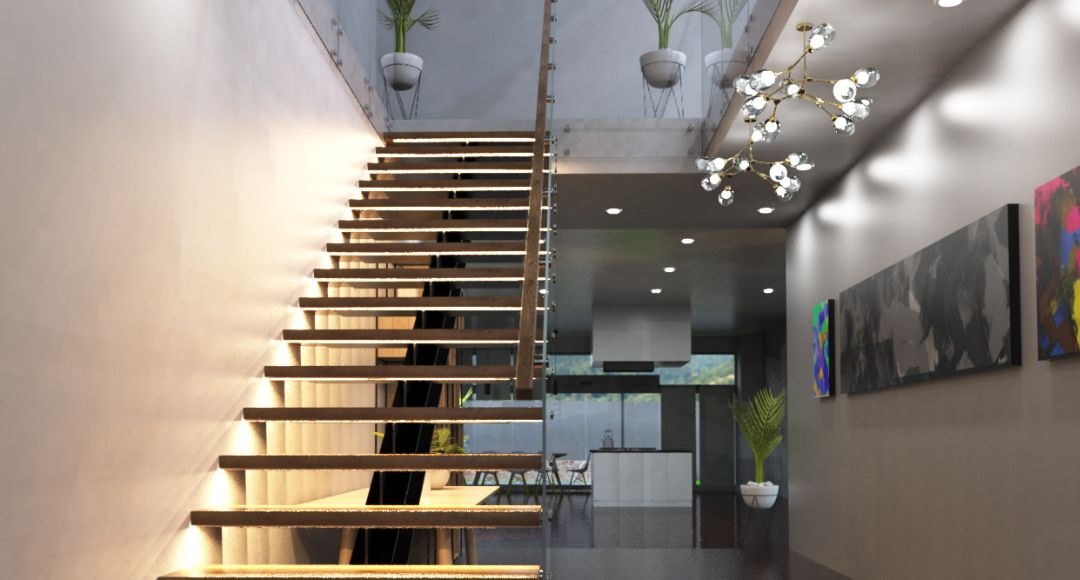
Picture this: instead of relying on a single overhead light for your stairs, you install lights on every step.
This way, each tread becomes subtly outlined, giving the staircase a clean appearance and making each step clearly visible.
Rather than flooding the entire area with brightness (which is often not the solution), per-step lighting draws attention to the staircase’s form. The edges contrast against the tread, so you know where each step starts and ends.
On the aesthetic side, this adds a precise, calm, and surprisingly elegant feel to the space.
A Continuous Glow
If per-step lighting isn’t your preference, there’s always the option of continuous lighting. This adds a softer appearance and can create the impression of a floating ribbon of light running alongside the stairs.
With this layout, you’re not highlighting individual steps; rather, you’re creating a gentle wash of illumination that guides the eye upward or downward through the space.
Warm Light Versus Cool Light
What gives the whole stair lighting setup the “oomph” is colour temperature. Different tones can achieve different lighting effects.
Warm lighting generally creates a more welcoming atmosphere. If your steps are made of timber or have a wood finish, this complements them beautifully. Warm lighting works particularly well in traditional interiors.
Cooler lighting, on the other hand, tends to feel cleaner and more modern. It can enhance stone, glass, and minimalist design schemes where crisp lines are the focus.
Which is better for your stairs?
It depends on the mood you’re trying to create. But a general rule of thumb is not to mix different colour temperatures. That typically does not work well for your lighting setup.
What you can do instead: whatever the colour temperature of the adjacent space or the landing is, use the same colour temperature for consistency.
Keeping the Effect Sophisticated
There is a reason why minimalist interior design has been booming in recent years. That’s because with restraint comes sophistication. And the same is true with staircase lighting.
This is why low-glare illumination is usually preferable to bright, exposed light sources. When the fitting itself disappears, and only the effect remains, the overall result feels more refined.
You also want your lighting to be consistent, as uneven brightness or random placement can make even premium materials look untidy. You want lighting that quietly supports the space, not one that competes for attention.
You can go all out when it’s time for Christmas decorations. But for everyday use, keep the lighting subtle.
Less is more, after all.
How Designers Typically Achieve the Look
Fortunately, creating the subtle, sophisticated, modern look doesn’t require anything particularly mysterious (or expensive).
Many contemporary staircase lighting schemes use compact fittings positioned within walls, along skirting lines, or integrated into individual steps. These fittings direct light exactly where you need it while keeping the source itself discreet.
Trusted LED suppliers like Simple Lighting offer a wide range of stair lighting kits to help you achieve an understated lighting effect. Make sure to check out the website today.
When lighting your stairs, the principle remains surprisingly straightforward: Illuminate the staircase itself rather than blasting the entire area with one central fitting.
Final Thoughts: Turning Function Into a Feature
Great staircase lighting isn’t about making a bold statement or adding extra parts. You only need to highlight what is already there. With the right lighting, you can transform a plain staircase from a functional necessity into one of the most memorable features in your home.
The beauty of this upgrade is that it doesn’t rely on expensive materials or dramatic architectural changes (no renovations!).
Perhaps that’s why staircase lighting continues to appeal to homeowners and designers alike. Not because it changes the staircase itself, but because it changes how we experience it.
All it takes?
A thoughtfully lit staircase that adds character without clutter, improves atmosphere without demanding attention, and enhances both form and function while remaining remarkably understated.
With all that said, don’t you think it’s finally time to give your staircase the attention it finally deserves?